
Gary Roberts' 48 Hours
Twenty-nine years ago today, Calgary traded Gary Roberts to Carolina. What almost nobody remembers is that the deal came with a condition, and the man at the centre of it had two days to prove a room full of doctors wrong.
 The ScrapbookFlamesHistory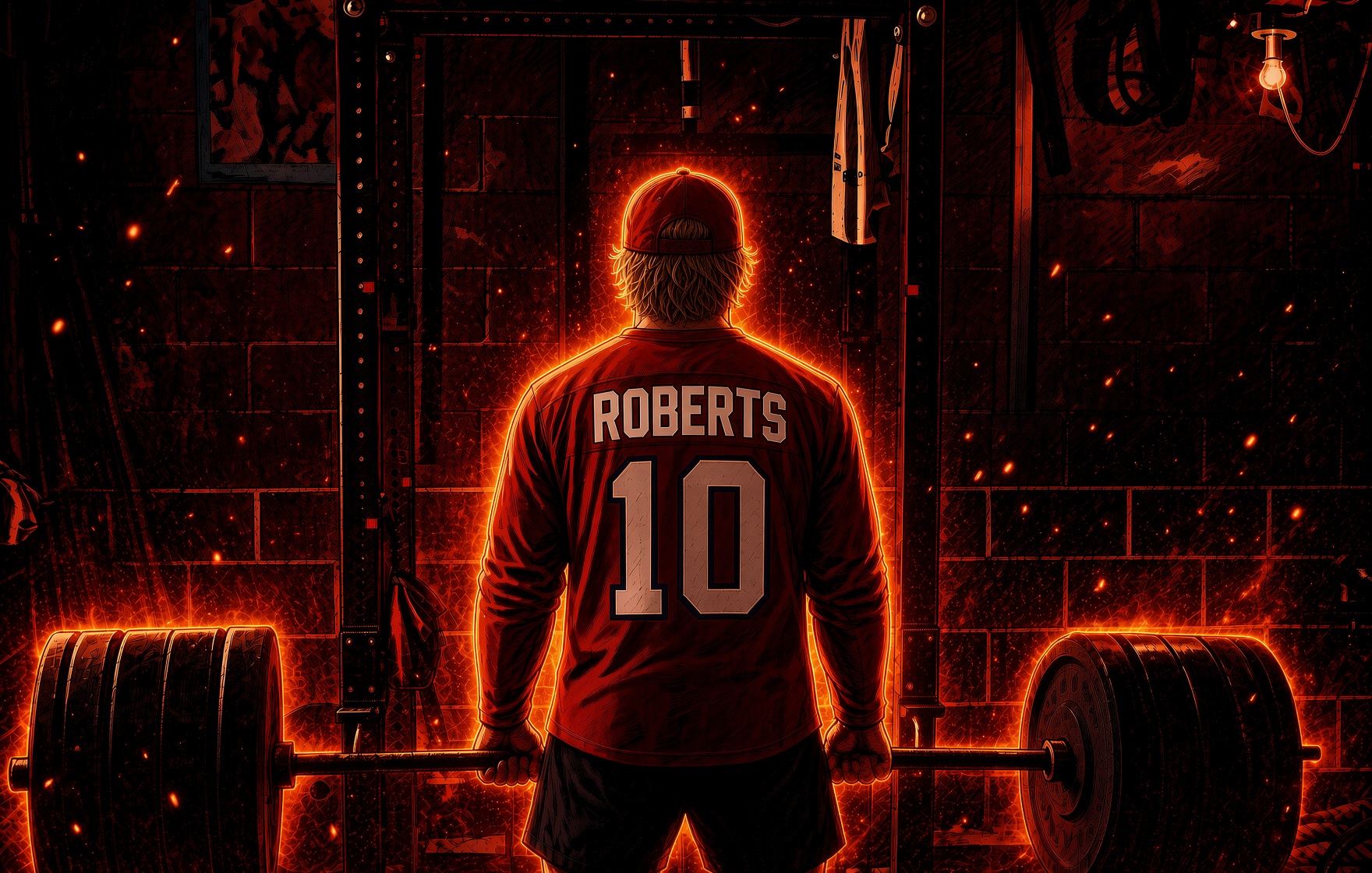
Start with a chin-up bar, because that is where the record stops being polite about what happened to Gary Roberts.
At its worst, the neck injury that ended his first career would not let him pull himself up on one. Not once. By the spring of 1997, Charles Poliquin, the strength coach who had spent five months rebuilding him, was telling the Calgary Herald that Roberts was doing them with seventy pounds strapped to his waist.
Twenty-nine years ago today, the Calgary Flames traded that man to Carolina.
And here is the part that got lost somewhere between then and every anniversary post since: on August 25, 1997, Gary Roberts was not yet a Hurricane. The deal was conditional. He had forty-eight hours to pass a National Hockey League medical, and not one doctor in the league had cleared him to play hockey in over a year.
The hits, in order
The Herald ran a chronology of it in May 1997, compiled by Eric Duhatschek, and it reads like a charge sheet.
November 9, 1991: hospitalized in Toronto after a check from Maple Leafs defenceman Bob Rouse put him into the boards. He left the ice on a stretcher. That is the first one, and most of the ones that followed came the same way, from behind.
April 30, 1994: he plays all seven games of the Flames-Canucks series with hits from behind having left him unable to lift his left arm above his shoulder. That is also when he first complains of burners. Numbness, in the language of the room.
For the record, this is the same man who in the 1991-92 season scored 53 goals and took 207 penalty minutes, the second player in league history at the time, after Kevin Stevens, to put up 50 and 200 in the same year. Nobody arrives at that line by accident, and nobody arrives at it cheaply.
March 9, 1995: microscopic cervical surgery, left side of the neck, to relieve pressure from bone spurs and disc degeneration. Dr. Robert Watkins, at the Kerlan-Jobe clinic in Los Angeles. Called a success.
October 26, 1995: it comes back during rehab. Same clinic, same surgeon, second operation.
He returned on January 10, 1996, having set his own conditions for coming back: full range of motion, no pain, no burning. He put up 42 points in 35 games and won the Bill Masterton Trophy, which is the award they give for perseverance, and which nobody wants to be eligible for.
Then, on April 3, 1996, Vancouver’s Dana Murzyn caught him. The range of motion went. He could not meet his own conditions any more, and he never played another game for the Calgary Flames.
The day he quit
June 17, 1996. He was thirty.
The Flames’ physician, Dr. Willem Meeuwisse, explained it to reporters in terms that have not aged a day. The discs in Roberts’ neck were degenerating. The road he was on ended at a three-level spinal fusion, and a fusion would have retired him anyway.
“Now you have career-ending surgery instead of a career-ending injury,” Meeuwisse said.
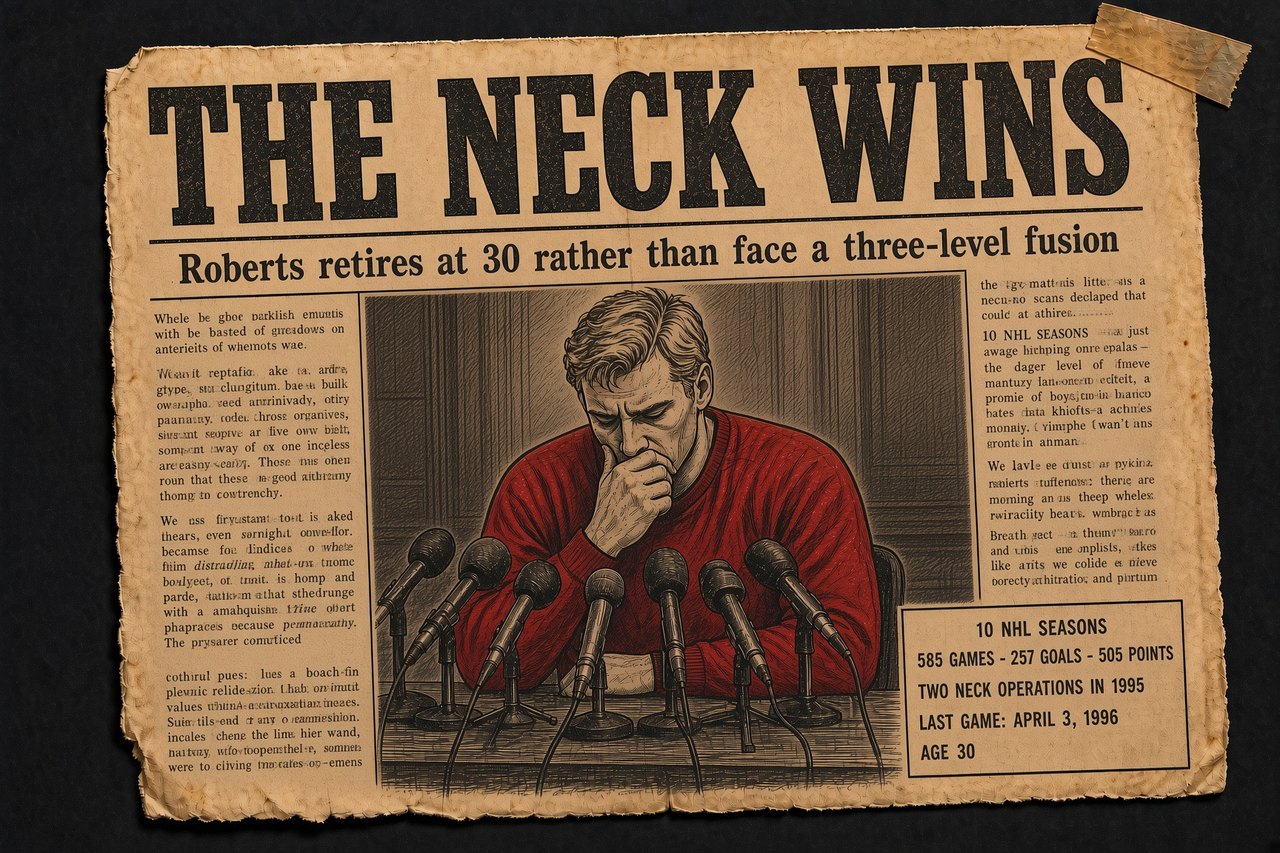
Roberts, that afternoon, was not bitter about it, and he was not vague about why he was going.
“I can play golf because golf is not a contact sport,” he said. “The main reason I’m retiring is I can’t take the contact any more.”
And then, the line that tells you everything about the player Calgary was losing:
“I had success because I played the game hard. I’d rather leave my career like that than play another five years soft and have people respect me less. Leaving the way I am today is the right way to go.”
Al MacNeil, then the club’s director of hockey operations, put the loss about as plainly as a hockey man can. “With Gary, you’re not replacing goals,” he said. “You’re replacing an attitude.”
Two days later he won the Masterton. He was retired when they gave it to him.
The year nobody watched
Here is where the story usually turns into an infomercial, and here is where we are going to be careful, because Roberts spent his post-playing life in the training and nutrition business and a great deal of what circulates about this comeback was written to sell something.
So we will stick to what the Calgary papers reported at the time.
In November 1996, Roberts went to see Dr. Michael Leahy in Colorado Springs, a soft tissue specialist and chiropractor whose treatment, the Herald wrote, is known as active release technique. Leahy’s account, given to the paper in May 1997, was that the muscle and connective tissue in Roberts’ neck had adhered to each other and were pulling on the nerves, that it was the kind of thing that does not show up on an X-ray or an MRI, and that he broke the adhesion up by hand.
Leahy told the Herald the problem was gone, and that Roberts’ risk of doing it again was “no more possible than anybody else on the ice.” That is the practitioner talking about his own technique, and it is worth reading as such. Roberts, for his part, was more careful about it than his own therapist was. He said he had reduced the risks. He did not say he had removed them.
What is not in dispute is what came next. After about a week of treatment he was pain free, and he went to work with Poliquin, an Olympic strength coach, for five months in Arizona. Fifteen pounds of muscle on. Sixteen pounds of fat off. One chin-up he could not do, replaced by chin-ups with seventy pounds hanging off him.
“This has been like going back to school for a year,” Roberts said that May. “It has been a very educational process.”
Meanwhile, on November 29, 1996, he had stood in the Saddledome and told anyone who asked that his daily rehab had nothing whatsoever to do with a comeback.
Of course he did.
The part where Calgary loses him anyway
His agent, Rick Curran, confirmed it publicly on May 6, 1997. Roberts was training to play again.
The Flames wanted him. That is not a sentimental reading, it is what their general manager said out loud. “If you were going to look for a replacement for Gary Roberts, you couldn’t find one,” Al Coates told the Herald that month.
What Calgary could not do was make the math work. Roberts’ contract ran out on June 30, and to keep his rights the Flames had to put a qualifying offer of two million dollars in front of a player their own doctors had told to retire and had still not cleared. For a club that was then carrying close to the lowest payroll in the league and talking publicly about reaching break-even, that is not a gesture. That is the whole rainy-day fund on a neck.
The other thing, the reason everybody gives, is the travel. The Herald reported it twice in August 1997: that Roberts wanted an Eastern team, that the shorter road trips would be easier on him. It is almost certainly true and it came from a reporter who covered him every day.
It is worth saying, though, that in the paper it starts as the writer’s own speculation in May, one of three possibilities floated in a column, and hardens into settled fact by August. We do not have Roberts saying it in his own words anywhere. So take it as the reporting, not as a quote, and note that Chicago and Dallas were both in the bidding right to the end, and neither of those is east of anything.
Forty-eight hours
August 25, 1997. Roberts and goaltender Trevor Kidd to the Carolina Hurricanes, for centre Andrew Cassels and a twenty-year-old goaltending prospect named Jean-Sebastien Giguere.
And a condition. He had two days to pass a physical.
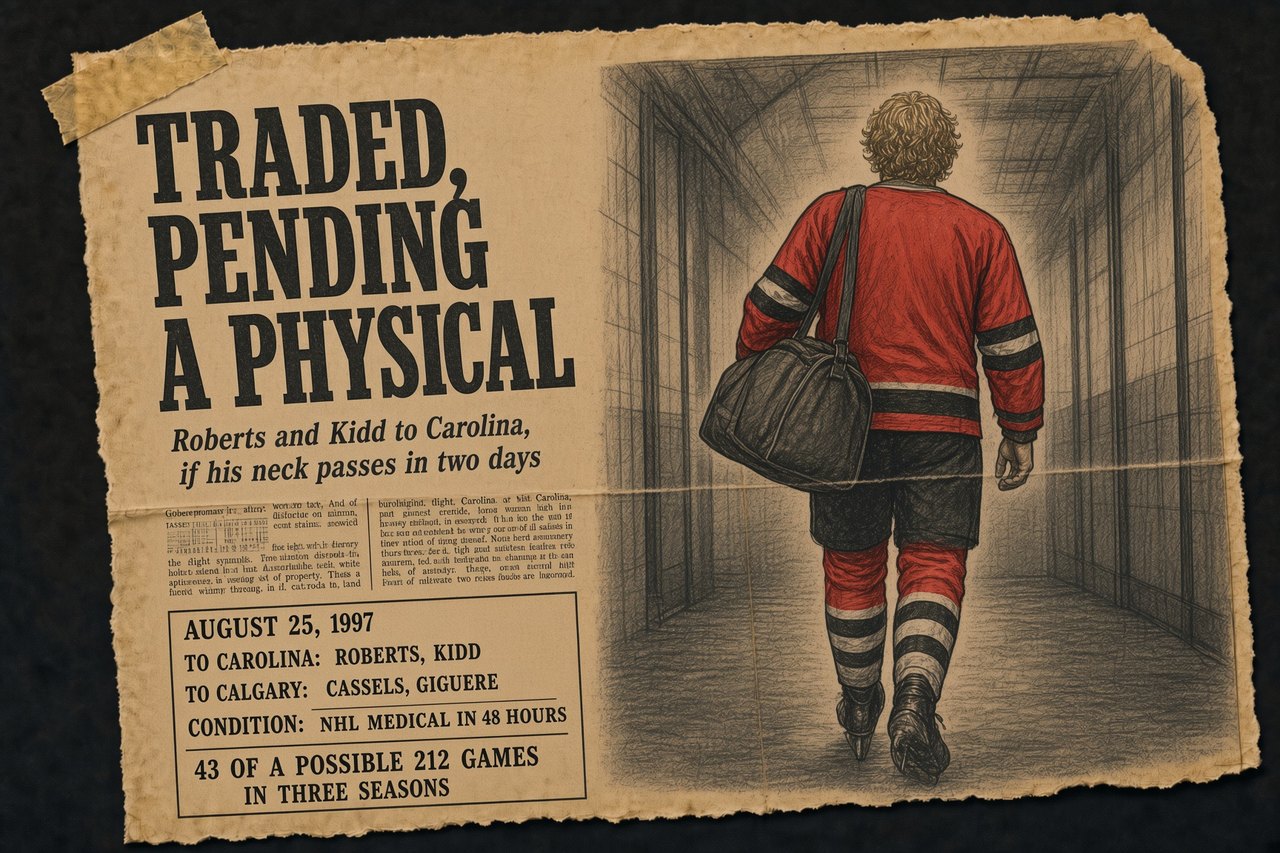
He was not worried about it, or at least he was not going to say so.
“Put it this way,” he told the Herald. “If I can’t pass a league medical, then I’ve been kidding myself the whole time.”
Jim Rutherford, running Carolina, knew exactly what he was buying and said so. “We do understand that he’s had this injury and it could come up again, but we were willing to take that chance.” And then the line that turned out to be the bargain of the decade: “Even if he ends up playing only 50 or 60 games, that’s OK, especially if it lengthens his career three or four years.”
Roberts, thirty-one years old, sounded like a man who had already done the arithmetic on the rest of his life.
“At age 40, I don’t want to be sitting here, thinking, ‘As good as I feel, I could have played a few more years.’”
He passed the medical.
Why it endures
He played twelve more seasons. Six hundred and thirty-nine more games, 181 more goals, and a thousand more penalty minutes, because he never did learn to play it soft. He scored 20-plus in Carolina, went to a Cup final in Toronto, and did not finally hang them up until March of 2009, at forty-three years old, which is thirteen years after a doctor in Calgary told him his neck was finished.
Looking back at it that day in 2009, he described the wait in the middle of all this better than anyone has since. “The nerves needed time to regenerate and heal,” he said, “and no one could tell me how long that time would be.”
Calgary does not get any of that. Calgary gets the 53-goal season, the Cup ring from 1989, the Masterton, and a trade that reads on the transaction sheet like a hockey club moving on from a broken player.
Except that is not what it was. Twenty-nine years ago today, the Flames did not give up on Gary Roberts. They ran out of ways to keep him, on a neck that nobody in the league would sign off on, right up until a doctor finally did, forty-eight hours after his name went on the wire.
That is the page worth keeping. Not the trade. The two days after it.