Paul Henderson's Escape from Canada
Sick of being a hero in Canada, the man who scored the goal of the century took a two-way deal with the Atlanta Flames on a trainer's salary and with a two-hour commute, just to keep his kids in an Alabama high school.


He got up at the usual time. He had breakfast with Eleanor and the three girls. Then he got in the car and drove two hours north, out of Alabama and into Georgia, to play a hockey game for the Atlanta Flames.
That was the commute. The Montreal Gazette described it that December, and the paper understood what it was looking at: the reason the Toronto Maple Leafs were no longer Paul Henderson’s last National Hockey League team was a two-hour drive.
“If Birmingham had been Toronto’s farm team, or anybody else’s, I would never have thought about going up,” he said. “But with Atlanta, it’s not that big a hassle.”
This week in 1979, the Atlanta Flames signed the man who scored the most famous goal in Canadian history. He was 36. It is the least-told season of a career everybody thinks they know, and it is a Flames page, even if the sweater said Atlanta on it.
What the record says, and what it does not
The old transaction lists put the signing on September 17, 1979. That is the date you will find on every this-day-in-hockey page, and every one of them is copying the same table.
I went looking for something from the time. The Calgary Herald’s transactions column for that Monday has Edmonton acquiring Jim Harrison and signing a kid named Mark Messier, Mike Bossy getting a multi-year deal from the Islanders, Tony Esposito re-signing in Chicago. It does not have Paul Henderson. Nobody in September 1979 thought a 36-year-old signing a two-way contract with Atlanta was worth a line of wire copy.
So take the day as tradition. The month is a matter of record. He was not one of the two players Atlanta signed on September 7, and when the Flames sent 19 men down to Birmingham on September 24 he was not one of them, because he was still in the big-league camp. September 1979, between the last WHA season and the first one after the merger. That is as close as the paper trail gets, and it is close enough.
The deal he asked for
Here is why he was a free agent at all. Henderson had spent five years in the World Hockey Association, the last three of them with the Birmingham Bulls, where he had scored 24 goals in 76 games in the WHA’s final season. When the leagues merged in the summer of 1979, Birmingham was not invited. The Bulls dropped into the Central Hockey League as the farm club of the Atlanta Flames, and the most famous name on the roster had a decision to make.
He could have gone home. Instead he did the arithmetic on his family.
“I would have been happy enough moving back to Canada but I looked at it from the point of view of my wife and my oldest two kids,” he told the Gazette. “They wanted to stay. My kids have always kind of sacrificed for me, for my career, and I thought now it was maybe my turn to sacrifice for them. The question I had to ask myself was: do you want to play in the minors? But then I realized hockey is hockey, no matter where you play it.”
Heather was 16 and Jennifer 14. Those are high-school years, and anyone who has moved a teenager knows what the arithmetic looked like. Jill, the youngest, was still in school with them when the Herald checked in a year later.
There was a practical side to it too. Without a green card he could not work in the United States, and the only work that kept the family in Birmingham was playing hockey. So when the Flames took over the Bulls, he picked up the phone.
“When I found out Atlanta was going to run the team here, I called and asked for a two-year contract and they gave it to me.”
Two years, two-way. The Gazette’s guess at his salary was “maybe $30,000,” and the paper’s own line on it is the best in the piece: his paycheque in Birmingham “might cover the trainer’s salary in Atlanta.” Henderson knew exactly what he was leaving on the table.
“I’d be making about four times as much,” he said, “but then, that doesn’t really mean that much to me. We have enough to live comfortably. Really, I’m playing for the love of the game here.”
That fall, when the Flames’ training camp broke, coach Al MacNeil told him there was a place for him on the NHL club. As the Gazette told it, Henderson “kindly countered that there was a better place with his family,” added that he would be available if injuries hit, and drove home to Birmingham.
Thirty games
Injuries hit. On November 21, 1979, Paul Henderson played his first NHL game in five years, against Detroit, the team he broke into the league with, and picked up an assist in a 4-1 win. Six nights later Toronto came to the Omni. He scored. His first NHL goal in more than five years went in against the Maple Leafs, and the Gazette noted that in his first four games back he had a goal and two assists, which is the line of a man doing the job he was hired for.
He went up and down the road all winter. The record for the season reads 30 games with Atlanta, 7 goals and 6 assists, and 47 games with Birmingham, 17 goals and 35 points. The way he told it a year later, he enjoyed it and knew what it was.
“Last year, when I came back to the NHL, I enjoyed it, but I knew it would be the last time.”
One of those 30 games belongs in the scrapbook on its own.
March 17, 1980, Maple Leaf Gardens
The Toronto Maple Leafs were in a bad way that week. Coach Floyd Smith had been hurt in a car accident the Friday before. Dick Duff was running the bench, the Leafs had lost 8-4 to the Rangers on the Saturday, and general manager Punch Imlach was telling the Canadian Press he would need “at least a couple of days” to decide who would coach the club for the rest of the season.
Into that walked the Atlanta Flames, and on the wing, a 37-year-old former Leaf who had walked out on the club for the WHA the day his contract expired.
The box score is a page worth keeping. Henderson set up Garry Unger’s opening goal in the first period. At 14:23 of the second he scored, from Unger and Willi Plett. At 19:09 of the third he scored again, from Guy Chouinard. Atlanta 5, Toronto 1, the Leafs’ fourth straight loss, and the Herald’s wire story the next morning had the only line that mattered: “former Leaf Paul Henderson scored twice to power the Flames.”
Henderson wrote in his 1992 memoir that he was named first star that night, and I will take his word for it, because the box score does not list the stars and the Gardens crowd was not in a position to argue. He was 37 years old, on a two-way contract, and he had just put three points on the team he had walked out on, in the building he had walked out of six years earlier.
Atlanta made the playoffs. Henderson played all four games of a first-round loss to the Rangers, which turned out to be the last playoff hockey the Flames would ever play in Georgia. That summer the franchise was sold and moved to Calgary.
The offer he turned down, twice
This is where the page becomes a Flames page, and it is the part most people have never heard.
The Calgary Flames wanted Paul Henderson. In the summer of 1980, by his own account, the club offered him a spot on the roster, partly to help bring along a young team in a new city. He had already said no to Atlanta’s coach once, at the end of camp, to go home to his kids. Now he said no to Calgary for the same reason.
“If I hadn’t liked it here, I would have looked for an NHL job three years ago,” he told the Herald’s Eric Duhatschek in February 1981. At the start of that season, Duhatschek wrote, “he said his family’s stability was more important than another shot at the NHL.” His three daughters were in a private Christian school in Birmingham and he did not intend to move.
There is a footnote to that no that only a Calgary reader will feel. The man on colour for the Flames’ radio broadcasts that first season in Calgary, and for the 21 seasons after it, was Doug Barkley. Barkley and Henderson had been Red Wings together for four years, from Henderson’s rookie season of 1962-63 until Barkley’s career ended in 1965-66. Had Henderson said yes, his first shift as a Calgary Flame would have been described on the radio by a man who had shared a dressing room with him at 20.
So instead of Calgary, he went back to the Bulls, as a player and an assistant to head coach John Brophy, an arrangement he described with the honesty of a man who never pretended to be a coach.
“I really didn’t take much part in the coaching, though,” he said. “His way of approaching the game is totally different from mine. So, I confined my thinking to his and didn’t really do a lot from the coaching end.”
He missed nearly half the year hurt and scored six goals. Then, on a Sunday in February, the Central Hockey League suspended the Birmingham franchise. The Bulls were done. On the Monday, February 23, 1981, Paul Henderson quietly retired.
“Early on, I knew things were going badly and expected something might happen,” he told the Herald. “But, we just came back from a 10-day road trip and we were ready to leave on another one for 15 days. I thought they would go on, at least for the rest of the season.”
He spent the rest of that winter scouting playoff opponents for the Calgary Flames. Asked how he felt about going out that way, he gave the answer of a man who had already made his peace with Atlanta a year earlier.
“You have to go out sometime. What’s the difference, anyway?”
Paul Henderson of Calgary Flames
He never played a game for Calgary. He never wore the sweater. But the record, if you look in the right place, says he was a Calgary Flame once.
June 16, 1980. The Canadian Press, from Oakville, Ontario, reporting on the American Airlines Canadian Golf Classic, a best-ball event with a field full of NHL players. John Marks of the Black Hawks and Greg Malone of the Penguins won it. Third place, at 199, went to “Garry Unger of Los Angeles Kings and Paul Henderson of Calgary Flames.”
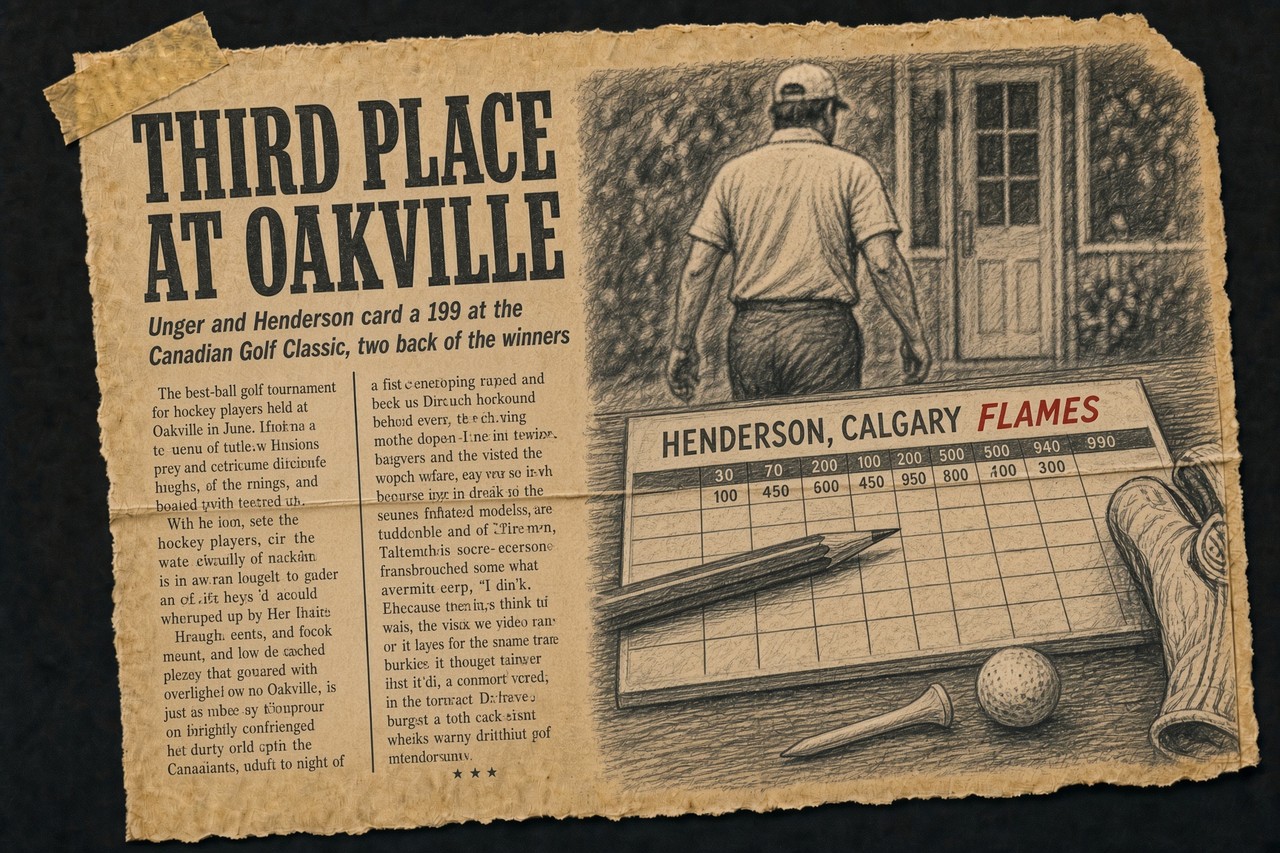
Unger, who had set up his goal at the Gardens three months earlier. The Flames, who had just become the Calgary Flames and had not yet played a game there. And Henderson, listed as one of theirs on a golf card in the Calgary Herald, the paper of a city he had already decided he would not be moving to.
Why the page is worth keeping
The Summit Series made Paul Henderson the most famous hockey player in Canada, and he spent the rest of the 1970s trying to get out from under it. “Coming to Birmingham was like a breath of fresh air,” he said in 1979. “I was so sick of being a hero. I wanted to go somewhere where nobody knew me.”
That is what the Georgia cameo was. Not a comeback, and not a defection either, whatever it looks like to a Canadian reading the word Atlanta. It was a father with three daughters in a school they liked, taking a two-way contract and a two-hour drive so nothing had to change at home. He got 30 games out of it, one perfect night in Toronto, and two chances to be a Flame in Calgary that he turned down for the same family, both times.
The Flames left Georgia. Henderson stayed in Alabama. And for one June weekend in 1980, on a golf course in Oakville, the Calgary Herald counted him as ours anyway. That is the page.
The other winger
The story above ends on a golf card. What follows is for readers who want to know how the two wingers from the 1972 line left the game in the same season, and what Henderson said he was looking for. Every line here is from the Gazette of December 29, 1979, or the Herald of February 24, 1981, and the sourcing is in our fact-check.
The same season. When the Herald reported Henderson’s retirement, Eric Duhatschek put one more name in the story. Ron Ellis, the other winger on the Clarke line in Moscow, “also retired involuntarily this season, in a shabby ceremony orchestrated by team owner Harold Ballard and general manager Punch Imlach. Ellis found out Toronto was buying out his contract for the remainder of the season when the nameplate over his locker was missing one morning.” So the two wingers who flanked Bobby Clarke in September 1972 went out in the same season, one because his league folded under him in Alabama, the other because his nameplate was gone in Toronto. The Herald’s word for Henderson’s exit was “quietly.” Ellis did not get that.
Why Toronto. The piece above says he was sick of being a hero. The Gazette’s version has more in it. After the Summit Series, Wayne Parrish wrote, “by season’s end, he had just 18 goals and a year later when his contract with the Maple Leafs expired, he jumped to Bassett’s Toronto Toros.” Henderson’s own accounting of the WHA years is one sentence long. “It was worth it, because it eventually got me out of Toronto.”
What he was looking for. This is the part of the 1979 interview that never makes the this-day-in-history pages. “All I could feel was this tremendous restlessness within me,” he told Parrish. “I was searching for something. I had healthy kids, a lovely wife, a nice home, and yet I knew something was missing in my life. There was no quietness.” His answer to what changed was one word. “God,” he explains. “I became a Christian in 1975. I decided to give my life to the Lord. Our whole family has grown so much in the last three years.”
Moby Dick. He knew how it looked from Canada, and he laughed about it. “Paul Henderson in Birmingham, Georgia?” he laughs. “You might as well have said I was Moby Dick.” That is how the Gazette printed it. Birmingham is in Alabama, and was in 1979. We have left the line as it ran, because a Montreal paper putting Birmingham in the wrong state is its own small proof of how far off the map he had gone.
What was next. In December 1979 the Gazette had his plan: “He hopes to work in the ministry once he obtains his green card, but for now he’ll continue playing with the Bulls, an old man in a young men’s league.” Fourteen months later the Herald had the other branch of it: “Should the CHL reinstate the Bulls’ franchise next year, still a possibility at this point, Henderson then would consider getting involved in some non-playing capacity. If it does not, Henderson probably will return to Canada and buy a farm.”
We will leave him there, in February 1981, with the two plans on the table, because that is where the two newspapers leave him. What he did with the rest of his life is a better-known story than the one above, and it is not the Scrapbook’s to retell. The page was always about the thirty games, and the golf card, and a man who kept saying no to Calgary for the right reasons.
Overtime is the part after the story ends. This one is on the site so you can see what they are. Every other Overtime is only in Weekend Clipboard.
 Next in The Scrapbook → Bev Ritchie's Building On October 15, 1983 the Saddledome opened, months late and $16.5 million over, with a name a maintenance worker and his son came up with in front of a hockey game. The first page of The Saddledome's Last Yee-Haw.