Nelson Skalbania's Two-Thousand-Dollar Night
Nelson Skalbania bought the Flames without, by his own count, a dollar of his own in the deal, then bet $2,000 on their first game against Edmonton and lost it. The first Battle of Alberta, October 22, 1980.

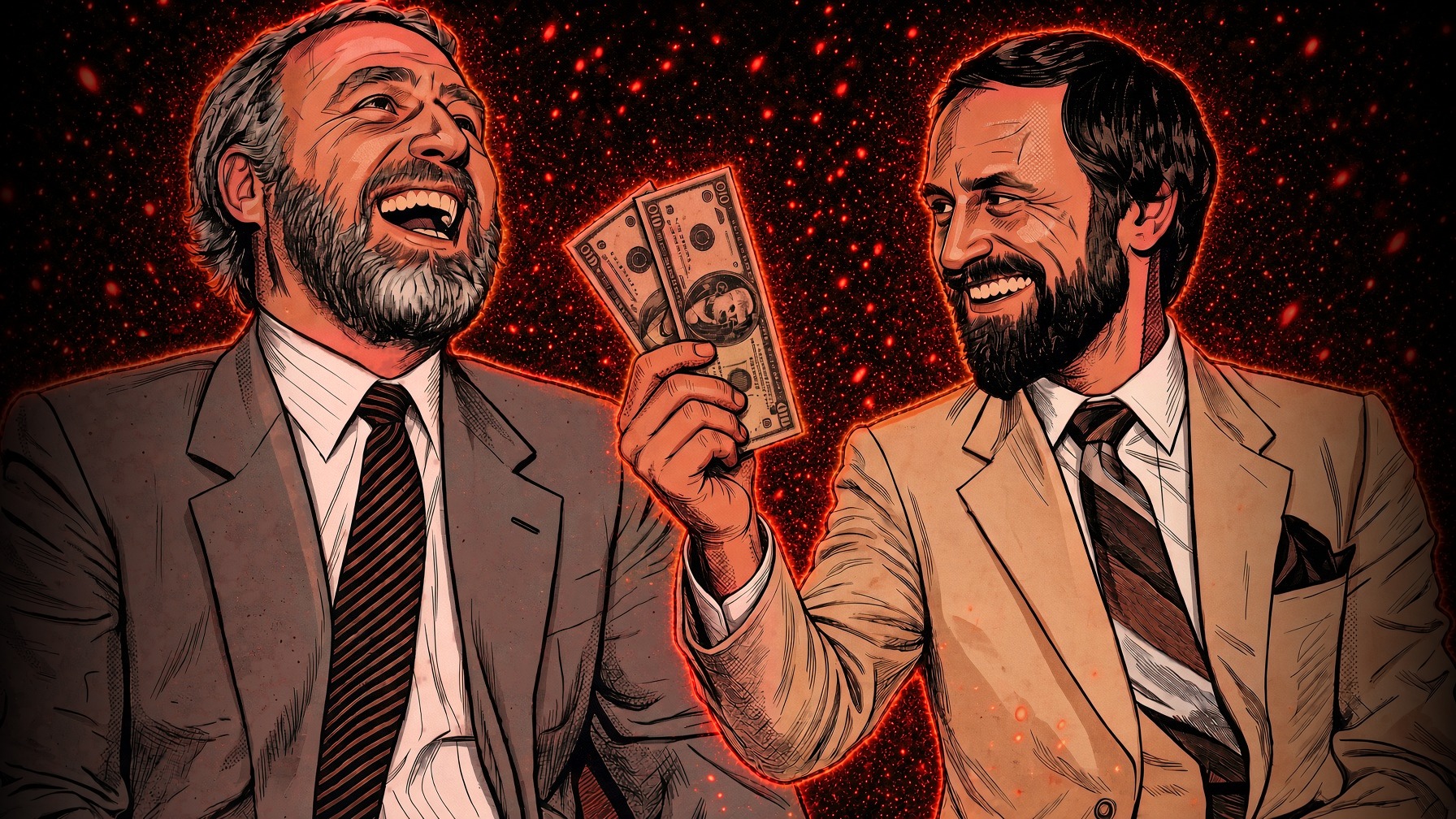
Nelson Skalbania lost two thousand dollars in Edmonton on a Wednesday night in October of 1980, and the man who took it off him was Peter Pocklington.
The two of them had been business partners once. Now Skalbania owned the Calgary Flames, in their first season since the move from Atlanta, and Pocklington owned the Edmonton Oilers and the 19-year-old who made them go. The Calgary Herald’s Eric Duhatschek opened his game story the next morning with the money. Pocklington had signed Wayne Gretzky to a 21-year contract on his 18th birthday, Duhatschek wrote, and it had cost him millions. On October 22 he got a little of it back.
“Two thousand dollars, to be exact. That’s how much they had wagered on the outcome of the first-ever meeting between Alberta’s two National Hockey League franchises.”
It was the second bet Skalbania had made on the Flames that year, and the smaller one.
A team for minus $200,000
The first bet was the team. In the spring of 1980 Skalbania, a Vancouver entrepreneur who conceded he did not do business in the ordinary way, bought the Atlanta Flames for $16 million and moved them to Calgary. He laid out how in an interview with the New York Times the following winter, and the Herald’s Larry Wood passed it along to Calgary in a column that February.
By Skalbania’s own telling, the deal was a $1 million non-refundable deposit, $6 million more within 30 days and the last $9 million within 60. He did not have the financing when he handed over the million. “I knew I had an idea of how to do it, and I did it afterwards,” he said.
The $6 million came from Molson’s, as an advance against $10 million worth of radio and television rights he presold to the brewery. For the $9 million he went to a group of Calgary oilmen who had been trying to buy the team themselves, and offered them 49 per cent on two conditions: that they give him back his million plus $200,000, and that they arrange the $9 million bank loan. They did.
“My total investment in the Flames today, I own 51 per cent of it, and my total investment out of my pocket, is minus-$200,000,” he told the Times. “Not many people can end up with 51 per cent of a team in the NHL with a minus-$200,000 investment. It’s kind of fun.”
So when he lost two thousand dollars to Pocklington at Northlands, he was, by his own arithmetic, out more on the one game than on the whole franchise.
The game
That was the first Battle of Alberta, on October 22, 1980, before anybody was calling it that. Edmonton won it 5-3, in front of a capacity crowd of 17,396 at Northlands Coliseum. The headline across the top of the Herald’s sports section read “Edmonton’s bragging rights are intact.” The best line in the story came at the very end, and it was the Oilers’ own dressing room saying there was nothing to brag about yet.
Gretzky, and the big winger beside him
The Flames came up the highway on a four-game unbeaten run, and this was the night it ended. They spent most of the first period finding out what everyone else in the league already knew.
Gretzky, Duhatschek wrote, controlled the game whenever he stepped over the boards, and that happened nearly every other shift. Calgary’s defence played him uncertainly, “even when he did not have the puck.” Dan Bouchard robbed him twice on clean breakaways. It did not matter much. Gretzky set up both of Dave Semenko’s goals instead.
Semenko is remembered as the man who rode shotgun for Gretzky with his fists, and that reputation was earned. On this night he was the finisher. He was 23, in his fourth season with the Oilers, and he had played the last three games on Gretzky’s line. He had six goals in those three games, which was the same number he scored in the whole of the season before.
“I knew I’d get lots of chances playing with him,” Semenko said. “What we’ve worked on in practice is for me to get in the right position to shoot the puck.”
Gretzky made it sound simpler. “Myself, Blair and whoever else is on our line let the puck do the work for us,” he said, Blair being Blair MacDonald. “It’s faster than any one of us can be.”
Two bad penalties
The game turned in a little over two minutes of the first period, and Calgary did it to themselves. The Flames took a penalty at 12:32 and Semenko scored on the power play at 13:14, Gretzky and MacDonald assisting. They took another at 13:56 and Paul Coffey scored at 14:40, with Mark Messier on the assist. Willi Plett got one back before the period was out, whacking in a pass from Kent Nilsson, who had been knocked down making it. It was the first goal a Calgary Flame ever scored against Edmonton.
Al MacNeil, the Flames’ coach, put it on the penalties afterward.
“I’ve said before that we can’t continue to take penalties like we have and not get burned,” MacNeil said. “We had two bad ones early and weren’t fortunate enough to kill them off. Still, we had enough chances in the last four minutes to pull it out, but we just couldn’t score.”
Edmonton pushed it to 4-1 in the second on goals by Don Murdoch, with Messier assisting again, and Semenko’s second. Brad Smith answered for Calgary. Kevin Lowe made it 5-2 early in the third, and Kevin LaVallee scored midway through it to make the final look closer than the game was. The shots were 31 apiece. Ron Low got the win.
The box at 11:47
Here is the part you have probably heard told differently.
At 11:47 of the second period, Jim Peplinski of Calgary went to the penalty box with a fighting major and an unsportsmanlike minor. At the same second, Mark Messier of Edmonton went with a fighting major of his own. Messier was 19. Peplinski was a young Flame a few years from being the kind of player stories got told about.
The modern histories of the rivalry say the two of them dropped the gloves, and that this was the first fight between the Flames and the Oilers. They may well have. Two fighting majors at the same instant is how most fights look on a scoresheet. But a scoresheet only records who was penalized, not who was swinging at whom, and the newspaper that covered the game does not settle it. The Herald’s summary lists the two majors and nothing more. Duhatschek’s game story, which found room for a $2,000 side bet, two breakaway saves and Semenko’s thoughts on practice, does not mention a fight at all.
That is worth sitting with for a second. The fight that every retelling of this night leads with did not rate a sentence in the paper the next morning. Nobody in 1980 knew it was the first of anything.
Three years later, on the Saddledome’s opening night, Peplinski and Messier were both thrown out of the same brawl inside the first fifteen minutes. By then people were starting to keep track.
Only in the fans’ minds
The Flames did all right against Edmonton the rest of that first season. They won 5-3 at the Corral on December 30, went back to Northlands on February 8 and won 10-4, and tied the last one 3-3 in March. Calgary took the season series, two wins, one loss and a tie.
Which brings us to the end of Duhatschek’s story, and the line this page is built around. He went into the Oilers’ dressing room after the game and asked about the rivalry. Here is how he wrote up what he found.
“The consensus among the players in the Edmonton dressing room was that a rivalry between the two clubs must develop. At the moment, it exists only in the fans’ minds.”
Then Gretzky, who was 19 and had already figured out most things about hockey.
“It will develop in the years to come. The players didn’t feel it, but the fans might build it up.”
He was right about the fans. He was a little modest about the players. Within a few years the two teams were meeting in the spring, and by the end of the decade the Battle of Alberta was the nastiest rivalry in the sport. Nobody had to ask the players whether they felt it after that.
But it started as a bet between two owners who used to be partners, a capacity crowd in Edmonton and a dressing room full of young men who did not think they were part of anything yet. Skalbania paid up. Within a year he had sold out to his Calgary partners, and one of them, Doc Seaman, said when it became official that “Nelson made a little money in the process.” The fans did the rest.
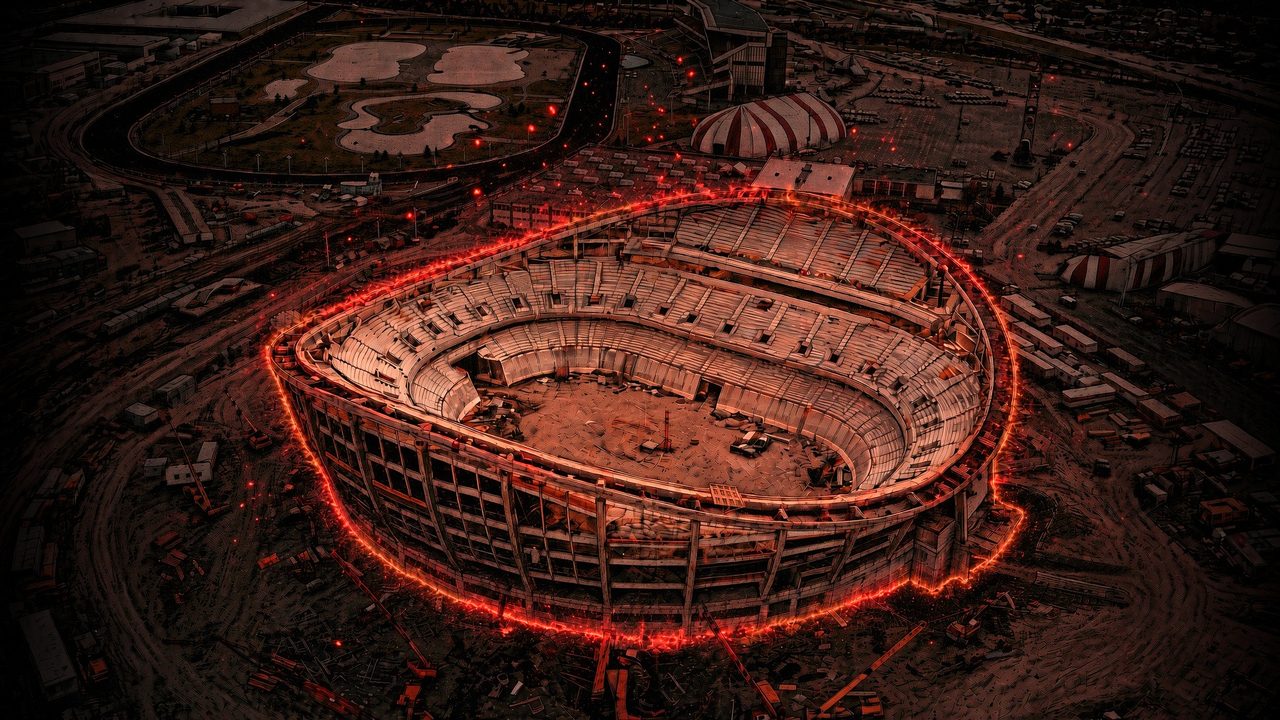 Earlier in The Scrapbook → Bev Ritchie's Building On October 15, 1983 the Saddledome opened, months late and $16.5 million over, with a name a maintenance worker and his son came up with in front of a hockey game. The first page of The Saddledome's Last Yee-Haw.