Jim Peplinski's Encounters with Cannibalism
Forty years after Game 4 at the Montreal Forum, the truth about Claude Lemieux and Jim Peplinski is stranger than the legend, and a good deal funnier.
 Tales from the Sin BinFlamesHistory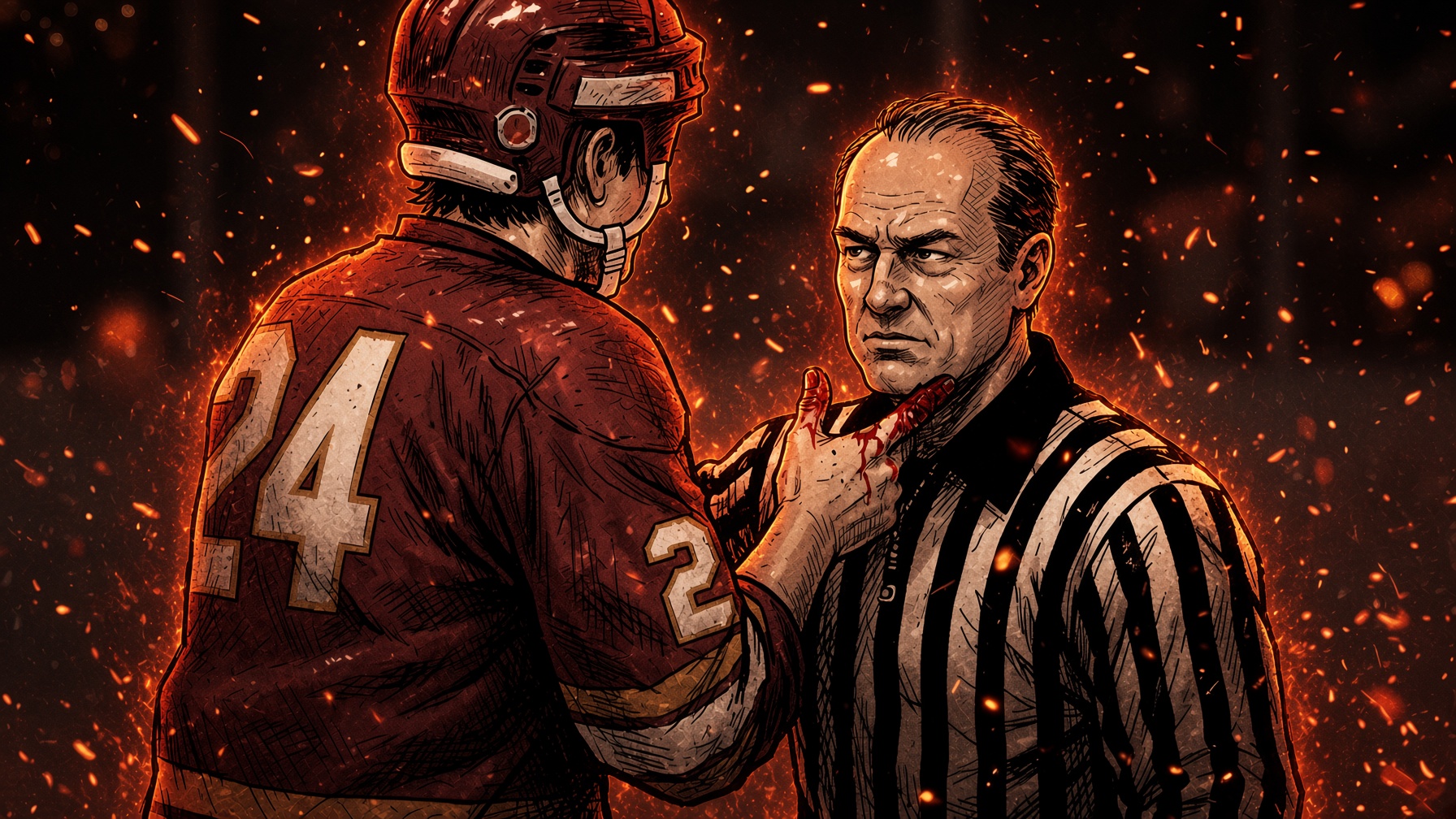
The horn goes, and nobody leaves.
That is the part people forget about May 22, 1986. The game was already over. Montreal had won it 1-0, Patrick Roy had made his fifteen saves and skated off, and the Canadiens were up three games to one in the Stanley Cup Final. Whatever anybody still had to settle, there was no hockey left to settle it in.
They settled it anyway, in small fires all over the ice, men taking hold of each other’s sweaters and not doing a great deal else with them.
The exception ended up down by the Calgary bench, where Jim Peplinski had gone looking for a twenty-year-old rookie named Claude Lemieux and found him. The man calling the game says it twice in twelve seconds, because it is the only thing on the ice worth calling: now Lemieux and Peplinski want to go. There they go.
Eight men were thrown out of the building that night. By the account of the men who were standing in it, there was exactly one real fight. This is the one, and somewhere inside it Lemieux got his teeth around Peplinski’s finger.
The two of them
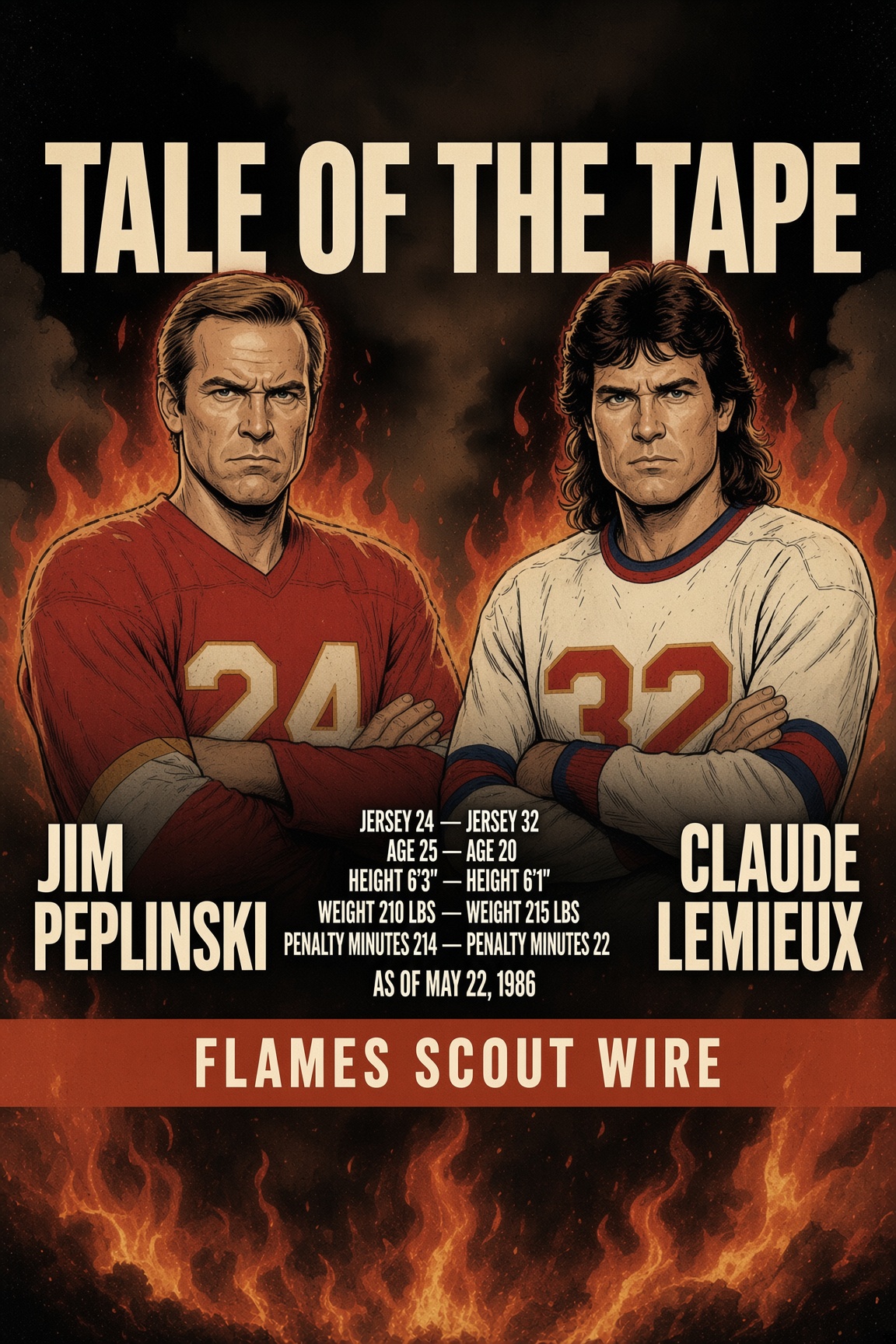
Peplinski was twenty-five and he was Calgary’s co-captain, which in that room meant sharing the job with Lanny McDonald and Doug Risebrough. Six foot three, two hundred and ten pounds, a left winger that season, drafted in the fourth round by a Flames team that still played in Atlanta. He had put up 24 goals and 214 penalty minutes that year, which tells you most of what you need. The part that doesn’t fit the sheet is that the same season he drew a couple of down-ballot votes for the Selke, the award they give the best defensive forward in the league. Two hundred and fourteen minutes in the box and somebody, somewhere, had him on a ballot for conscientiousness.
Claude Lemieux was twenty, and he had played ten games all year.
Ten. That is the whole regular season. Then Montreal put him in the lineup for the playoffs and he scored ten goals in twenty games on the way to a Stanley Cup, which is the kind of thing that happens once in a franchise’s memory. He was not a tough guy in the sense Calgary understood the term. He was something more irritating than that, and he was very, very good.
The night, before anyone bit anyone
The brawl gets remembered as the whole evening. It wasn’t. The evening had been building all series.
Chris Nilan, the man Montreal usually sent to handle this sort of thing, was not dressed. He had sprained an ankle fighting Calgary’s Tim Hunter two nights earlier and spent Game 4 at the end of the bench in a pinstriped suit, which did not stop him running the shop from there. The job went instead to John Kordic, a rookie, who went looking for Hunter and found him, and finished the night with a black eye and a swollen jaw for the trouble. The one shot he landed all evening was a crack about the size of Hunter’s nose.
Kordic was refreshingly direct about it afterward. Everyone wanted to look like a hero and a tough guy, he said. He was just looking for Hunter, because Hunter was their tough guy.
The broadcast of the last few minutes plays like a list. Terry Johnson grappling with Craig Ludwig. Chris Chelios winding up and putting a right hand flush onto Paul Baxter’s face, which the fight databases would later file as something else entirely, opposite a man Baxter never touched. That one is its own story. And Kordic at the end of it, once everything had burned down, skating around waving his own teammates toward the tunnel. It was that kind of night.
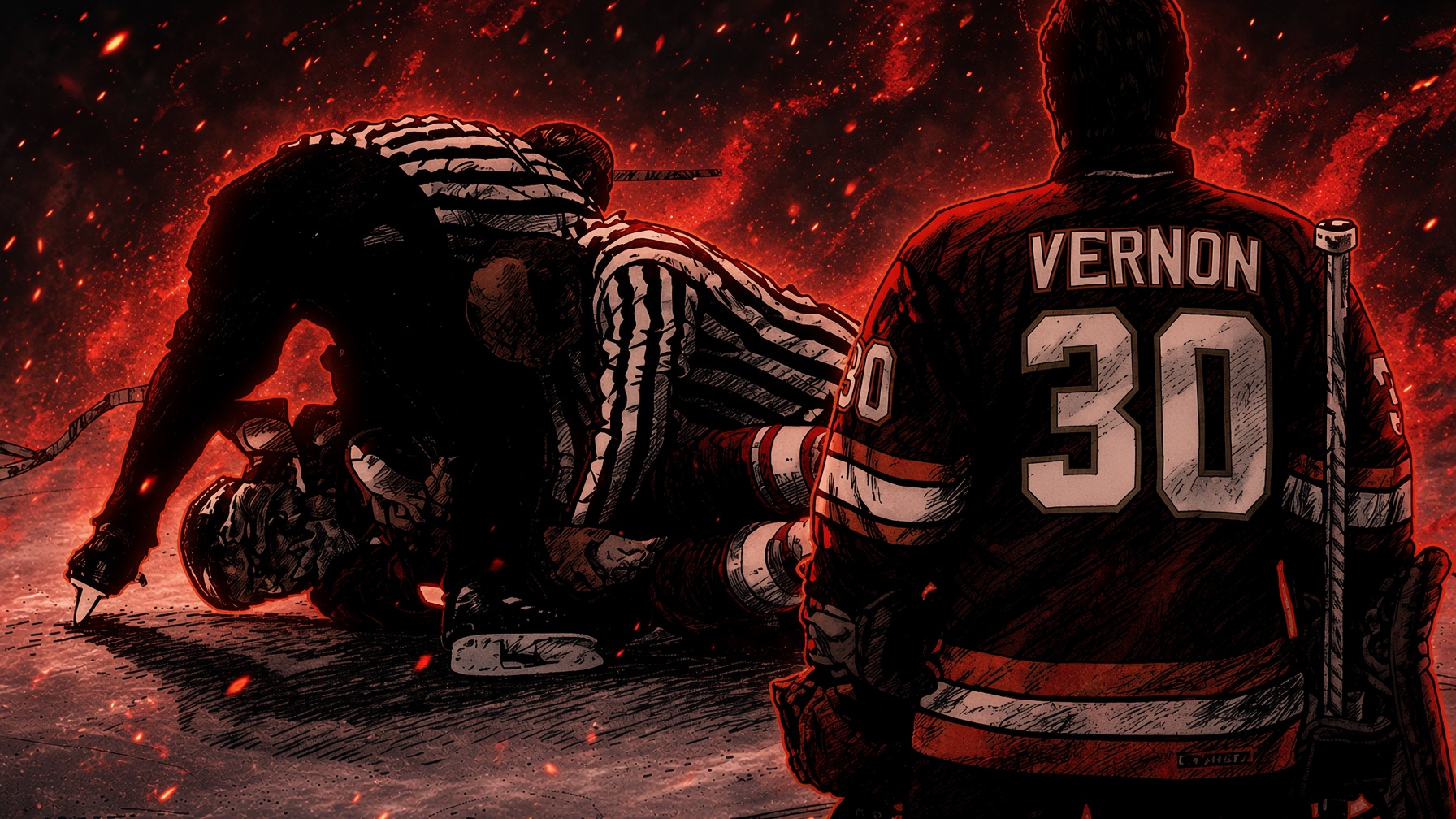
One Calgary player stayed out of it. When the horn went and the rest of them drifted toward Patrick Roy, the New York Times has everybody going except Vernon, who wanted no part of any of it. It did him no good at all. When the bill came down the league charged every player on both rosters the same five hundred dollars, goaltenders included, and Mike Vernon paid his for standing still.
Jean Perron, Montreal’s rookie coach, called the whole business most unfortunate and said these sorts of things shouldn’t happen, that the players should go off the ice at the end of the game. His own general manager was blunter. Serge Savard, who had won a great deal in that building as a player before he ever ran the team, said they had to get rid of this phony stuff in hockey.
The best line came from Bob Gainey, who understood exactly what he had just watched. During the game, he said, everyone was too afraid of taking a penalty to do anything about all the high sticks and shoves you were getting. After the game, it’s easy.
The fight itself
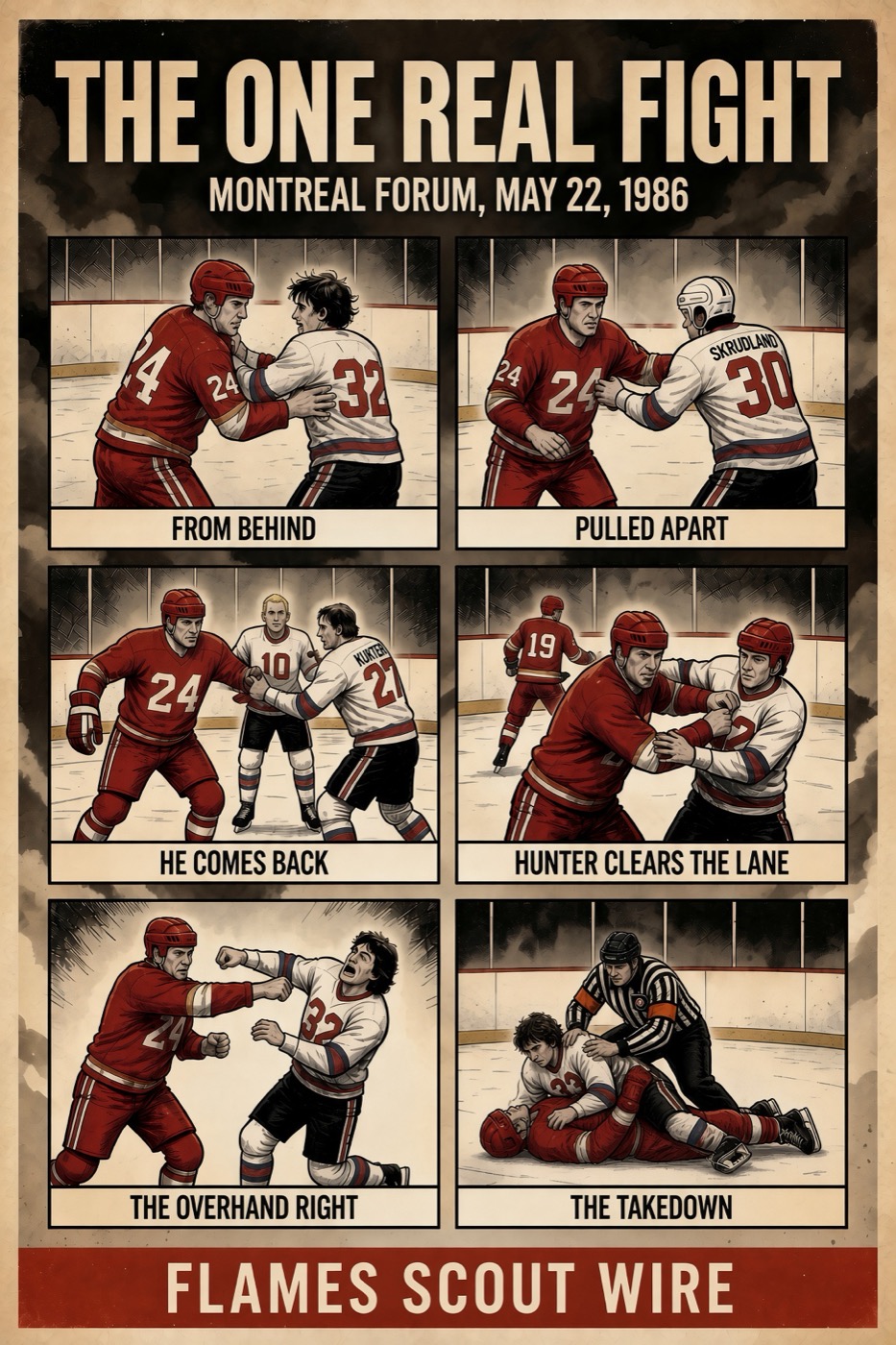
Almost nobody has ever written down what actually happened, so here it is, off the tape.
Lemieux is near the far corner next to his own goal, on the edge of a scrum, not paying much attention to what is behind him. What is behind him is Jim Peplinski, who arrives and catches him in a headlock.
That is how this starts, and it is worth saying plainly, because after forty years of retelling, some versions have it the other way round. Peplinski went and got him.
For a moment, before anyone can reach them, Lemieux looks frightened. He was twenty years old and a man five inches taller had come out of nowhere and got an arm around his neck, and it reads on the tape about the way you would expect.
Brian Skrudland pulls them apart. Peplinski lets go, Lemieux backs off, and the whole knot of them drifts up the ice toward the Calgary bench.
Peplinski is not finished. He drops his gloves and goes at Lemieux a second time, and now there are two Canadiens in front of him, Skrudland again and Kordic alongside him.
Which is when Tim Hunter earns his week’s pay. He puts himself in front of Kordic, takes a fistful of Skrudland’s sweater, and the traffic clears.
Lemieux is on his own. Peplinski throws first.
What happens next would surprise anybody who thought they were watching a mismatch. Lemieux comes back with four quick rights. Then Peplinski catches him with an overhand right, and for a second it is finished: Lemieux reels backward with his legs going soft under him, the way a man does in the half-second before he sits down on the ice.
He doesn’t sit down. He drops his head, steps in, and shoots for Peplinski’s right leg, a single leg takedown Jacques Rougeau would have been proud of, and he puts the bigger man on his back. Now they are both down and it is the twenty-year-old throwing the flurry. A striker and a grappler, with the grappler on top.
Both linesmen jump in.
And in the middle of being pulled apart, Lemieux gets both hands onto Peplinski’s face.
Then he squirms free.
The bite
Here is what is genuinely known, from the two papers that printed it the next morning.
Lemieux bit Peplinski’s finger. The ice was red from all the blood. That is the Los Angeles Times, in those words, on May 23, 1986. The New York Times has it too, a day later.
Bob Johnson, Calgary’s coach, was asked about it directly and gave an answer that has aged into something stranger than he meant it:
“I didn’t see how it started. Lemieux bit Peplinski’s finger. They’ve got it on tape, and it’s pretty clear. I’m not sure, do you have to get a (penalty) shot after something like that?”
Peplinski, for his part, declined to make a meal of it, which given the circumstances was restrained. He’s a good hockey player, Peplinski said, he’d give him that. But it’s a little frustrating when he tries to bite your finger off.
Lemieux said two different things to two different scrums, and both got printed. In one he ends on the note that he thinks Peplinski will remember him. In the other, offered to a different reporter, he allowed that it might have been a stick he bit. Neither is a confession and neither is a denial. Take your pick, or don’t.
What Peplinski added years later, in a 2011 interview, is the part everybody repeats: that Lemieux had been scratching at his eyes, that the finger went to the bone, that he needed a tetanus shot afterward. The eyes check out. You can see both of Lemieux’s hands on his face on the tape. The bone and the tetanus shot are his memory alone, twenty-five years on, and neither is in the contemporary reporting, which is not nothing and is not the same as the record.
The finger-showing, at least, is on the tape. You can watch him skate over and hold the thing up as evidence, which is a very reasonable response to having been bitten in a hockey game.
He shows it to a linesman. Look at the top of this page again: no armbands on that sweater, and in 1986 the referee wore them.
That matters, because in the 2011 telling he shows it to the referee, and he names the referee, and the man he names never worked a minute of the 1986 Final. Andy van Hellemond had the game that night, with Bob Hodges and John D’Amico on the lines. So what happened is the most forgivable thing a memory can do: he took a linesman he could see and, a quarter of a century later, promoted him.
What the tape does not have is sound. The reply Peplinski remembers getting, that the official had no way of knowing he hadn’t done it to himself, is his account and nobody else’s. It is a wonderful line and it may well be exactly what was said. We will leave the man in the stripes anonymous and let the sentence stand.
The tape that nobody has
Go back to what Johnson said. They’ve got it on tape, and it’s pretty clear.
They do not, or if they ever did, nobody has produced it in forty years.
The footage that survives shows the wrestling near the Flames bench. It does not show the bite. The announcers never call it either.
What the tape does show, a minute or so later, is Claude Lemieux alone on the ice with blood coming out of his right eye, running down his face and dripping off his chin. A little after that he is picking at the eye as though something is still in it, a bruise already coming up underneath, while an off-ice official in a blue suit leans in to have a look.
So the tape is full of blood. None of it is identifiably Peplinski’s. And the one review anybody ever wrote of this footage says the television edit was poor and that only one pairing in the whole bench-clearer was a clear-cut fight: Lemieux and Peplinski.
So the most famous bite in hockey history exists in the record the way most old hockey stories do. Two newspapers, one coach, and the man it happened to.
The sentence he probably never said
Which brings us to the line.
Ask anyone about this and you will get it back word for word: that Peplinski said he didn’t know they allowed cannibalism in the NHL. It is on the highlight packages. It is in the retrospectives. It is, by now, the only thing a lot of people know about Jim Peplinski.
Nobody has ever produced a 1986 source for it.
It is not in the Los Angeles Times game story. It is not in the New York Times. It is not in the 2011 interview that every modern retelling traces itself back to, the one where he actually did talk about the bite at length. The earliest datable appearances are all from 2011 onward, and one of the first of them puts the whole incident in the wrong year.
What he actually said, that night, with the finger still bleeding, was that it’s a little frustrating when he tries to bite your finger off. Which is funnier, honestly. It is the sound of a man who has decided not to give the reporters what they came for.
The league, for its part, fined nearly everybody in the building and issued a statement about the brawl that did not mention the bite at all. Johnson noticed that publicly. Nobody ever answered him.
Three years
Here is the ending, and it is a good one.
On May 25, 1989, Calgary and Montreal met again in Game 6 of the Stanley Cup Final, and Calgary won it 4-2 to take the series and the only Cup this franchise has.
Claude Lemieux had a night. He scored Montreal’s first goal early in the second period. He set up their second in the third. And then, at 18:34 of that third period, with the building emptying out and the Flames about to take the Cup off his ice, he picked up a roughing minor and a ten-minute misconduct and was sent off. Twelve penalty minutes, one goal, one assist, and an early shower in the last two minutes of a season.
Jim Peplinski was not in the lineup.
Neither was Tim Hunter. Both of them wore a letter for that team, and both of them watched the clinching game of a Stanley Cup Final in sweats, because the third man who wore one had just come back into the game.
Lanny McDonald was at the end of his career and he had gone thirteen playoff games without scoring, and Terry Crisp had sat him down for a stretch of the Final. For Game 6, Crisp put him back. He scored in the second period, and the box score logs it as his first goal of the entire postseason. Two roster spots had to give for that, and they were Peplinski’s and Hunter’s.
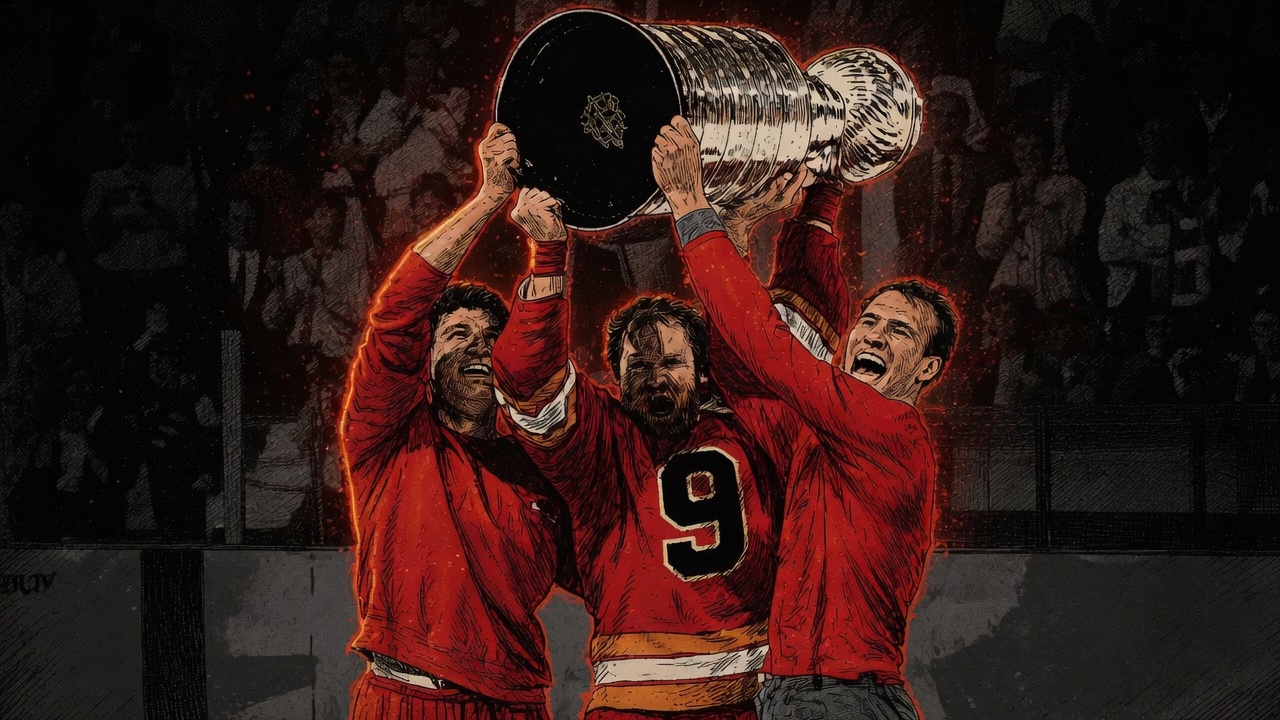
Then the part that Calgary has been retelling ever since, and which Sportsnet went back over on the thirtieth anniversary. When the Cup came out and was handed to McDonald, he did not raise it. He called his two co-captains over so the three of them could hoist it together. There is a classic photograph of that moment. If you grew up here, you have seen it.
So Peplinski’s name is on the Cup, and it belongs there: 79 games and 241 penalty minutes of a co-captain’s season, and a photograph of him holding the thing in his sweats. He retired six games into the following year, twenty-nine years old, having won it.
The man who got bitten finished with a ring and a good story. The man who bit him finished that same night in the penalty box, and then in the tunnel, on the wrong end of it.
Why it endures
Claude Lemieux died this past May, at sixty.
The last word on all of this should probably be his and Peplinski’s together, and by a stroke of luck it can be. Ahead of an alumni game in 2011, the two of them traded emails. Peplinski joked about what Lemieux might bring along, given their history: Tetanus, maybe. Lemieux wrote back that he would bring vodka instead. In the same conversation Peplinski said he’d have liked to play alongside a guy with that kind of intensity, rather than across from him.
That is the whole story of the Sin Bin in two men and one bad night. It looks like hatred from section 210. It is very rarely hatred up close.
One ugly minute at the Montreal Forum bought Jim Peplinski a lifetime of being asked about a sentence he never said. He seems to have made his peace with that, and with the man who caused it, which is more than most of us manage about a finger.