
Tim Hunter's Black Magic
He was a middleweight in a league of giants, so Calgary's sheriff invented a fight trick nobody could solve. They called it black magic. Here's the move, and the one man it never worked on.
 Tales from the Sin BinFlamesHistory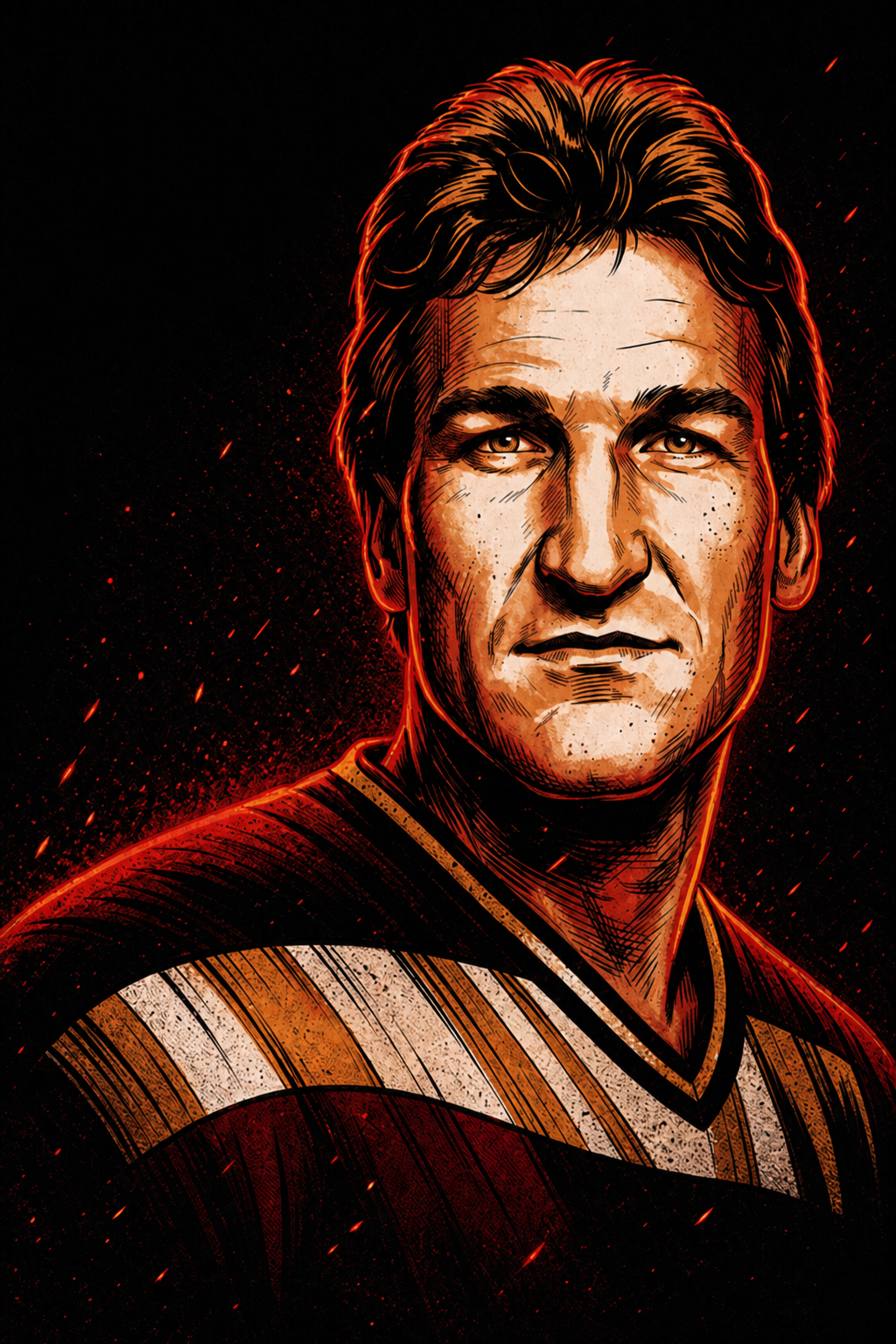
Picture it. The gloves are already on the ice, and Tim Hunter has a fistful of a man half a head taller than he is. The big fellow’s right arm, the punching arm, is folded across his own chest and going nowhere, and Hunter’s left is very much free. Somewhere in the building, somebody reaches for the only word that fits a smaller man taking a giant apart.
Black magic. The name stuck because nothing else explained it.
Tim Hunter stood six foot two and went about 200 pounds, which sounds big right up until you line him up against the men he actually fought. Edmonton had Dave Semenko, Don Jackson, and later Marty McSorley. Detroit had Bob Probert. Philadelphia had Dave Brown. Hunter fought all of them, most of them more than once, and he mostly won. In an era built for giants, that was not supposed to be possible.
A middleweight in a heavyweight town
Understand the job first. Hunter was Calgary’s sheriff for eleven seasons, the guy who answered for whatever happened to Joe Nieuwendyk, Theo Fleury, and Lanny McDonald. He did it at a size that, by enforcer standards of the 1980s, was a genuine disadvantage. The men across from him were bigger, and several of them hit like the end of the world.
He made up the difference with two things nobody could teach: conditioning and technique. For the record, this is not nostalgia inflating a fourth-liner. Hunter led the entire NHL in penalty minutes twice, 361 in 1986-87 and 375 in 1988-89, and both are still Calgary single-season records. His 2,405 career penalty minutes are the most in franchise history. He fought well over 200 documented times. You do not survive that volume against that competition on toughness alone. You need an edge.
The grip
Here is the edge, and it is beautifully simple.
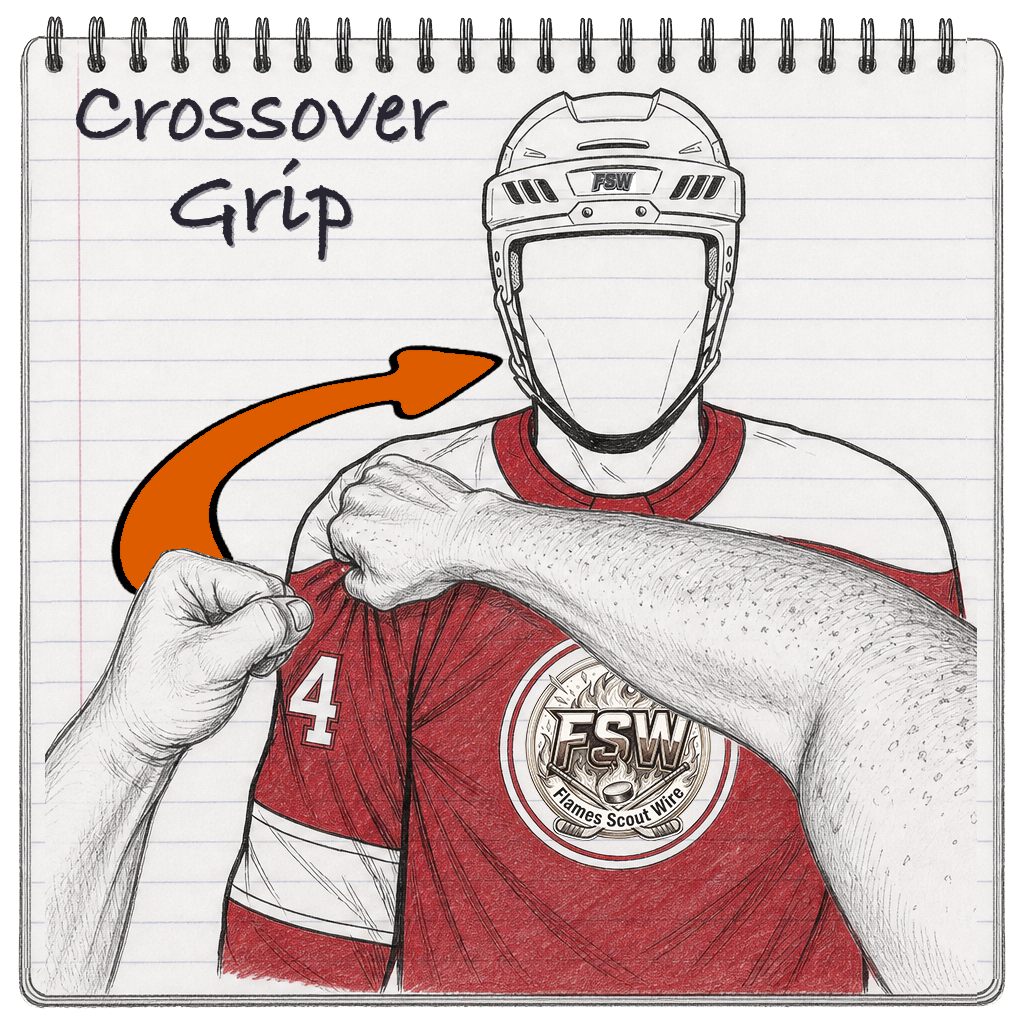
A standard hockey fight starts with each guy grabbing the other’s jersey with one hand and throwing with the other. Grab with the left, punch with the right. Hunter flipped it. He would reach his right hand all the way across his opponent’s body and tie up their right arm, the punching arm, before it could do anything. That left the bigger man with one hand pinned and no offense, while Hunter’s own left stayed free to work. He turned every fight into a one-way conversation.
Against giants who were used to trading blows, that was maddening. They had the reach and the power, and none of it mattered, because the hand that delivered it was folded up and going nowhere.
Slaying the beast
So where did the name come from? Legend has it, one night in particular. The way the story’s been passed down, Hunter first unloaded the crossover grip on Semenko during the 1983 playoffs, the spring Edmonton and Calgary met in the Smythe Division final. Semenko was the most feared man in the sport, the fellow whose literal job was keeping the world off Wayne Gretzky. Hunter got hold of him, killed the right hand, and went to work, and Semenko could not get out of it.
A giant, helpless, dismantled by a middleweight. Nobody had a tidy explanation, so they reached for the untidy one.
The era was insane, exhibit A
To appreciate what Hunter was operating in, borrow a story Gretzky has told. Hunter and Oilers tough guy Kevin McClelland went at it in front of the Edmonton bench during a game that was already a blowout. Hunter landed one so cleanly it broke McClelland’s nose sideways, pointing it east to west across his face. McClelland, bloodied and rearranged, turned to his own bench and screamed that it did not hurt, that he had not felt a thing. Gretzky says Hunter stopped and just stared, and the whole Oilers bench rose off the seat. That was the room Hunter clocked into every night.
The one man the magic didn’t work on
Every good trick has a counter, and Hunter was honest about his.
The crossover grip was built for right-handed fighters. Dave Brown threw left. A southpaw scrambled the whole geometry, and worse, Brown was the one heavyweight Hunter openly admitted he fought with caution. Hunter said he watched Brown crush the orbital bones of two other NHL heavies, Stu Grimson and Jim Kyte, and that he warned other fighters off trading with him. One clean shot from Brown could end a career. Against everyone else Hunter had an answer. Against Brown he had respect and a very careful plan.
There is no code
The other lesson came early, and it left a mark.
In one of their first meetings at the Corral, Hunter held his own against Semenko, which was not supposed to be possible. Feeling good about it, he stuck his chin out to let Semenko know. Semenko waited for the linesman to step in, then threw a sucker punch over the official and caught Hunter flush. Hunter said years later that it taught him the truest thing he ever learned about the job: there is no code. He and Semenko eventually became friends and laughed about how much they had once hated each other. The punch stayed with him anyway.
Why it still matters
Hunter won a Stanley Cup in 1989. He was a two-time nominee for both the Masterton and the King Clancy, the trophies that go to character guys, and he won the Flames’ humanitarian award. He went on to a long coaching career. The penalty minutes are the headline, but the part worth remembering is that Calgary’s most prolific fighter got there by being the smartest man in the fight, not the biggest.
They called it black magic. It was really just a guy who did his homework.