
Paul Baxter's Wrong Guy
The record says Paul Baxter fought Guy Carbonneau in the 1986 Cup Final, and that he won a ring on the Flames bench in 1989. He did neither. The story of a man the books keep putting in rooms he was standing next to.
 The ScrapbookFlamesHistory
Picture the Forum with four seconds left. Montreal is up 1-0 and about to go up three games to one, and nobody on the Calgary bench is looking at the clock any more. The horn goes. The Flames drift toward Patrick Roy, Roy leaves, and everyone else on the ice arrives at the Montreal net at roughly the same moment. Somewhere in that pile Chris Chelios winds up and throws a right hand at Paul Baxter.
The man calling the game finds it before he can name it:
“I want to tell you, Chris Chelios just threw a right that landed on somebody’s… Paul Baxter’s, I believe. He landed one solid on Baxter, I’ll tell you there.”
That is the fight. Now go and look it up, and you will be told something else entirely.
I was not there. Nobody at this desk was. What follows comes out of a shoebox: a game sheet, two newspapers printed the next morning, and six minutes of broadcast footage somebody thought to keep. Which turns out to be the whole trouble with Paul Baxter. Everything anyone knows about him is something somebody else wrote down.
The fight that isn’t there
Search Paul Baxter and May 22, 1986 in the fight databases and you will find him matched against Guy Carbonneau.
It is a wonderful story, which is probably why nobody ever checked it. Carbonneau was Montreal’s shutdown centre, a future three-time Selke winner and eventual captain, a man who fought maybe a dozen times in nineteen seasons and better than 1,300 games. A number that small is not a style, it is closer to an accident. Calgary’s most penalized defenceman squaring off with a man who never squared off with anyone: that writes itself.
It also never happened.
For the record
Here is what is genuinely true about that night, from the game sheet and the next morning’s papers.
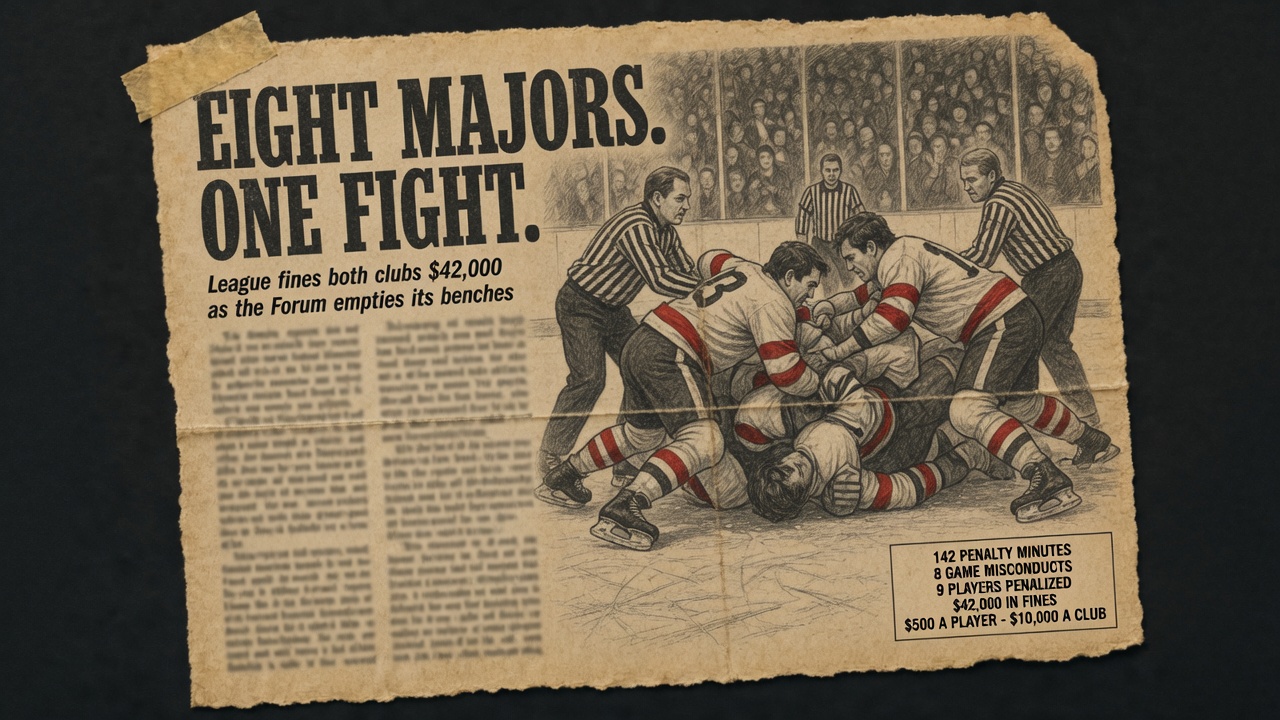
Andy van Hellemond handed out eight game misconducts, four to a side, inside 142 penalty minutes. Montreal’s went to Claude Lemieux, Chelios, Carbonneau and Mike Lalor. Calgary’s went to Jim Peplinski, Baxter, Steve Bozek and John Tonelli. All eight also took a five-minute fighting major, every one logged at 20:00 of the third, which is the game sheet’s way of saying after the horn.
The league fined the clubs, the coaches and the players a combined $42,000, the largest fine in NHL history at the time, five hundred dollars a man right down to both starting goaltenders, who had done nothing at all. President John Ziegler called the whole business appalling. He had announced, one day earlier, that fighting penalties were up fifteen per cent on the season and that the league intended to look into it.
The night was faintly ridiculous before anyone dropped a glove. Calgary refused to play until their bench was moved back from the boards, on the grounds that Montreal’s sat eight inches further back and theirs made line changes harder. The benches were bolted down. An hour before face-off, Forum workmen came out with tools and moved it. Camil Desroches, who had been around that building for most of half a century, was unimpressed. The bench doesn’t play, does it, he said. I’ve been here 48 years and I never knew anything was wrong with the bench.
What the tape shows
The footage survives, and it disagrees with the databases almost everywhere.
Chelios fought Baxter. The broadcast calls it live, and the Los Angeles Times put it in the next morning’s paper in plain words: Tonelli high-sticked Lalor behind the Montreal net just after the game ended, Chelios then went after Baxter, and separate skirmishes flared up all over the ice.
Carbonneau was wrestling Steve Bozek, which the film shows plainly enough to settle it. Tonelli and Lalor ended up tangled inside the goal, which makes sense once you know the whole pile formed at the Montreal net. Peplinski and Lemieux were the only two men actually fighting.
And there was a fifth pair nobody counts, because it drew no game misconduct: Doug Risebrough scuffling with Bob Gainey, his old Montreal teammate and close friend. Nine men were penalized that night, not eight. Risebrough said afterward that it meant nothing.
So the record has Baxter with Carbonneau and Bozek with Chelios. The tape has Baxter with Chelios and Bozek with Carbonneau. Two names, swapped.
Worth saying plainly, because it is the part the fine total hides: there were eight fighting majors handed out at the Montreal Forum that night and, by the account of a man who was standing in it, one fight. It was mostly just wrestling, Steve Bozek told the New York Times afterward. Once you’re at this level, you’re not about to do something that could end somebody else’s career, or your own, just for the sake of a fight.
How a fight gets invented
A box score records who was penalized, what for, and when. It does not record who anybody fought. There is no column for it. There has never been one. Eight men took fighting majors at 20:00 of the third and the official record says exactly that and not one word more.
Somebody, at some point, took those eight names off the penalty log and paired them up. Four Montreal, four Calgary, sorted into tidy couples. Two of the four happened to be right. The entry has been sitting on HockeyFights since at least March of 2010, which is only the earliest date the Internet Archive holds a copy, so sixteen years is the floor and not the ceiling. It carries no video. It has one vote.
You can watch the same machinery slip on a game where the league’s own paperwork survives. That database lists Baxter fighting both Paul Coffey and Dave Hunter on April 20, 1986 in Edmonton. Baxter’s actual penalties that night were a high-sticking major and a slashing major. He took no fighting major at all. Two men penalized on one sequence became two fights, because the log looked like it said so.
None of this is anybody’s villainy. It is a fan-built database doing its honest best with a document that cannot answer the question being put to it.
One footnote, because it is the reason anybody remembers this brawl at all. The single genuine fight ended with Claude Lemieux biting Jim Peplinski’s finger. Lemieux died this past May, and that story deserves more room than a paragraph here can give it. Consider this a marker. There is a piece in that finger for another day.
What is worth asking now is why the mistake keeps landing on the same man.
The wrong guy
The phrase in the headline was supposed to be about Carbonneau, a peaceable centre who picked the wrong night to be standing near a defenceman. With the tape in hand it turns out to belong to Baxter, in the older sense of the words. The wrong man. The one the description fits closely enough that nobody looks twice.
Because this was the shape of Paul Baxter’s spring. He played thirteen playoff games in 1986 and finished with fifty-five penalty minutes and a single assist, on a Peplinski goal in Game 1 of the Final. He dressed for one of the seven games against Edmonton in the Smythe Division Final. Against St. Louis he played five of six. Against Montreal he played most of the Final.
Including this. Calgary won Game 7 in Edmonton on the night Steve Smith banked the puck off Grant Fuhr and into his own net, the most famous game in franchise history and the one every Flames fan alive can still describe. Baxter was a healthy scratch.
Nobody has ever put on the record why, and this is not the place to invent a reason. The record just says what: he was in the room, he was not in the game.
What he could actually do
Here is the part that never gets told, and it is the part that argues with everything above.
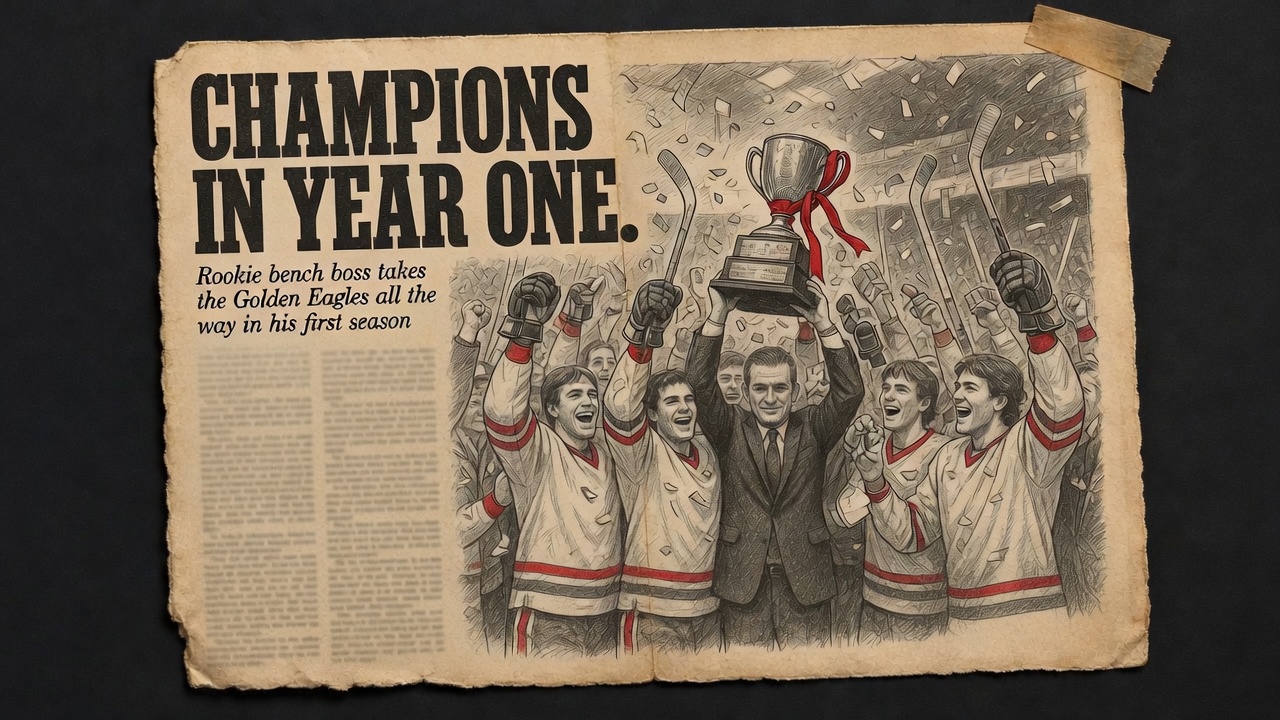
Baxter finished playing in 1987 and walked straight into coaching, and he was good at it immediately. He took over the Salt Lake Golden Eagles, Calgary’s farm club in the International League, and won the Turner Cup in his first season behind a bench. Not a near miss. A championship, first time out.
The next year he had them at 56-22-0-4, 116 points, first in the West. That is not a man haunting the edges of anything. That is a coach.
Just next door
Which is what makes the spring of 1989 land the way it does. He was not in Calgary for it. He was in Salt Lake, losing a Turner Cup final to the Muskegon Lumberjacks, while eight hundred miles north the Flames beat Montreal and won the only Stanley Cup this franchise has.
Look him up today and you will read that he was on that bench. His Wikipedia page says it. So does his own Manitoba Hockey Hall of Fame biography. Terry Crisp’s staff that spring was Doug Risebrough and Tom Watt, with Glenn Hall on the goaltenders. Baxter is not among them and his name is not on the Cup. Calgary hired him on June 28, 1989, a month and three days after the parade.
Then they gave him the bench he had earned, and the era ended underneath him.
The 1989-90 Flames were defending champions and they were good: 42-23-15, ninety-nine points, first in the Smythe, first in the whole Campbell Conference, second overall in the league. They lost in the first round to the Los Angeles Kings in six games. Game 4 was a 12-4 loss that is still the club record for goals against in a playoff game.
That was not Paul Baxter’s doing, and nobody has ever said it was. He was one assistant on a staff. But it is the game the lights went out on. Calgary would not win another playoff round until 2004.
Why the page is worth keeping
Ask a Flames fan for the two nights the franchise is built on and you will get the same two answers every time. Steve Smith banking it off Fuhr in 1986, and the Cup coming home from the Forum in 1989. Paul Baxter was inside this organization for both of them and in the room for neither, and the books have quietly moved him into both.
Two things in the reference books about him are wrong, and they are wrong in the same direction. The fight database moves him from the edge of the pile into the middle of it, opposite a man he never touched. The biographies move him from a rink in Utah onto a Stanley Cup bench in Calgary. Neither error makes him smaller. Both make him more central than he was.
That is what happens to a man who spends five years standing next to the moment. In the brawl but not the fight. On the roster but not in Game 7. In the organization but not on the bench. The record keeps rounding him toward the story, because he was always close enough to round.
The true version is quieter and a good deal more interesting. He took a punch from Chris Chelios in a pile at the Montreal net. He won a championship the first time anyone handed him a team. And when the Flames finally lifted the Cup he had chased as a player, he was in Salt Lake, coaching somebody else’s kids, weeks away from the Calgary job he had already earned.
That is the page worth taping in. Not the fight he never had, and not the ring he never got, but a Calgary Flame who was there for all of it and is filed, in two separate books, somewhere he wasn’t.
He was the wrong guy, all right. Just never once the way the story goes.