Grant Fuhr's 23 Weird Games
Twenty-seven years ago today, Calgary signed up the goaltender who had spent a decade beating them. He arrived as the number one, had to waive a no-trade clause to get here, and gave the Flames one great night out of a hard year.

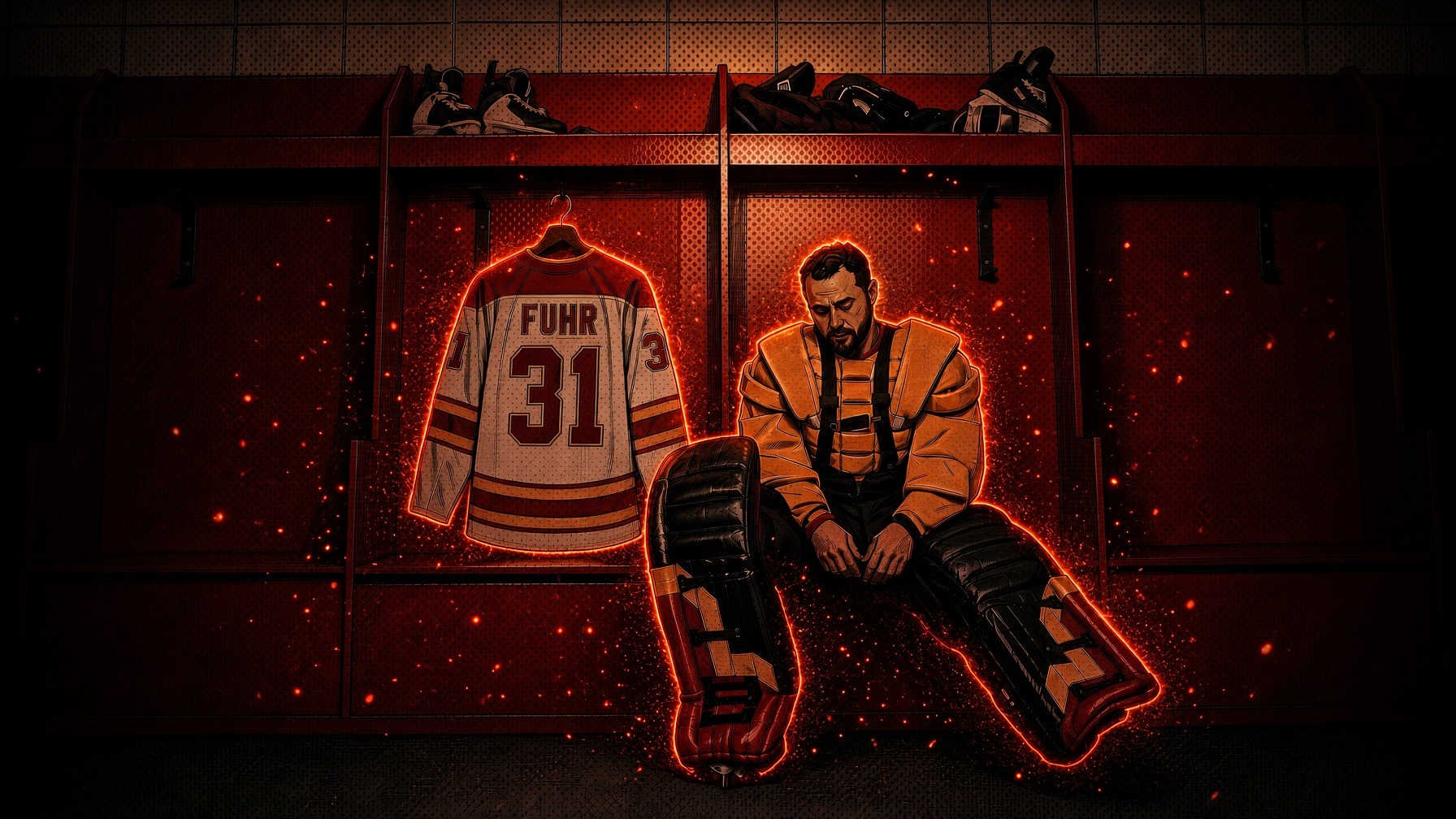
Start with the sweater, because everybody involved did.
“It will probably take me awhile to get used to wearing that jersey,” Grant Fuhr told the Calgary Herald on September 5, 1999, from his house in St. Louis. Glen Sather, still running the Oilers, put it less politely. “It will be very weird seeing Grant in that uniform.”
Twenty-seven years ago today, the Calgary Flames went out and acquired the man who had spent the 1980s standing between them and everything they wanted.
What it cost, and what the record does not say
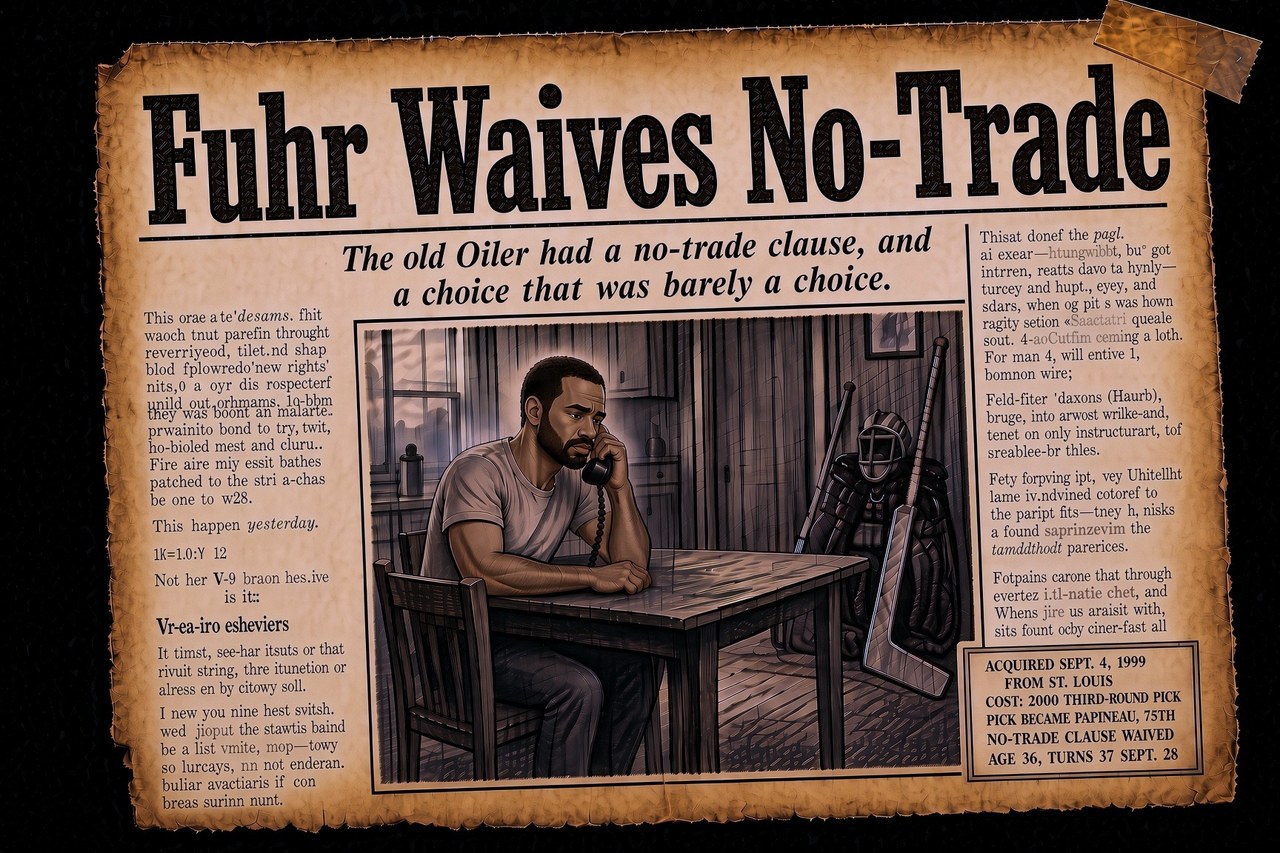
September 4, 1999, a Saturday. Calgary got Fuhr from the St. Louis Blues for a third-round pick in the 2000 draft. St. Louis used it at 75th overall on a centre named Justin Papineau.
That is the version in the transaction databases, and it is incomplete in two ways.
The first is money. The Herald reported that the Blues were “said to be picking up a portion of his $3 million US salary, perhaps even as much as half the amount.” A pick is what the record shows. Salary is what actually moved.
The second is the part worth keeping. Fuhr had a no-trade clause, and he had to waive it. The Blues told him on the Friday night that they wanted to send him to Calgary. If he said no, the reporting at the time was that he was headed for waivers, where the Flames would have tried to claim him anyway. So he was choosing between the Flames and the Flames.
He waived it. Asked why, he gave the answer this whole page exists for.
“But they asked me nice,” chuckled Fuhr.
The Flames wanted a starter, and said so out loud
There is a version of this story where a proud old goalie comes to town to mentor the kids and ride out the string. That is not what Calgary announced, and it is not what anybody said in September.
The Herald’s story ran under the headline “Flames welcome Fuhr: Old nemesis becomes a net gain,” and its first sentence left nothing to interpret: “The Calgary Flames No. 1 goaltender this season will be Grant Fuhr.”
General manager Al Coates had a model in mind, and it was the Buffalo Sabres, who had gone to the Cup final with Dominik Hasek behind a young team.
“I remember when John Muckler was in Buffalo and he said that a team develops a lot quicker with Dominik Hasek in net,” Coates said. “The confidence level that the players get playing in front of a guy like that goes up.”
He was blunter about what the club had been missing. “We are committed to winning and winning now. In this case, our chances of winning have improved. We haven’t had a goalie of this calibre here since Mike Vernon left.”
Coach Brian Sutter argued the same case from the other end. “He might not be in his prime, but he has been outstanding in his last few seasons. He is the biggest reason that St. Louis made the playoffs last season.”
The evidence was real. Fuhr had come back from knee surgery the previous season and closed it out 9-4-3 with a 2.11 goals-against average and a .912 save percentage, playing 16 of the Blues’ last 18 games. He turned 37 on September 28, three weeks after the trade.
The man who ended it was now his captain
The strangeness of it was not lost on anyone in that room, and one player embodied it exactly.
Fuhr came into the league with Edmonton in 1981 and played in every Oilers and Flames playoff series of that era. He lost one. The one he lost was 1986, when a Calgary clearing attempt came off an Oilers defenceman’s stick, banked in off Fuhr’s own pad, and sent the Flames to the Stanley Cup final instead of Edmonton.
The defenceman was Steve Smith. By 1999, Steve Smith was the captain of the Calgary Flames.
Asked about his new goaltender, Smith did not reach for the joke.
“In his prime, he was the best pressure goalie I have ever seen,” he said. “When the door had to be shut, he was there to close it.”
What the season actually did
The number one job lasted about as long as the season took to go wrong.
| 1999-2000 | Games | Record | Save % | GAA | Shutouts |
|---|---|---|---|---|---|
| Fred Brathwaite | 61 | 25-25-7 | .905 | 2.75 | 5 |
| Grant Fuhr | 23 | 5-13-2 | .856 | 3.83 | 0 |
| Jean-Sebastien Giguere | 7 | 1-3-1 | .914 | 2.72 | 0 |
Twenty-three games. Five wins. No shutouts. Brathwaite, a 27-year-old who had been nobody’s plan, took the crease and did not give it back.
And look who else is on that list. Jean-Sebastien Giguere, 22 years old, seven games. Calgary had acquired him in August 1997 in the deal that sent Gary Roberts and Trevor Kidd to Carolina. Two summers later he was the third goalie in a room where the club had just spent a draft pick and half a salary on a 37-year-old to play ahead of him.
The one night
October 22, 1999. Calgary was 1-5-2 and had just been beaten 7-1 in St. Louis, in front of the club that had traded him. Sutter had gone after his team publicly. There had been meetings, official and otherwise.
In Florida the next night, the Flames won 3-2 in overtime. Derek Morris scored 20 seconds in, over the shoulder of the Panthers goaltender.
Fuhr had spent the first period keeping it from being over, kicking out three shots in close on one Panthers power play, sticking out a leg to rob Oleg Kvasha from the side of the crease. He finished with 29 saves.
It was his 400th win. Only five goaltenders in the history of the National Hockey League had ever got there.
“Finally something good,” he said. “I think you can tell by the guys in here and how they are acting that we feel pretty good about this one.”
Morris was less restrained. “What can you say? It is Grant Fuhr. He is one of the best players in the game and he was at his best.”
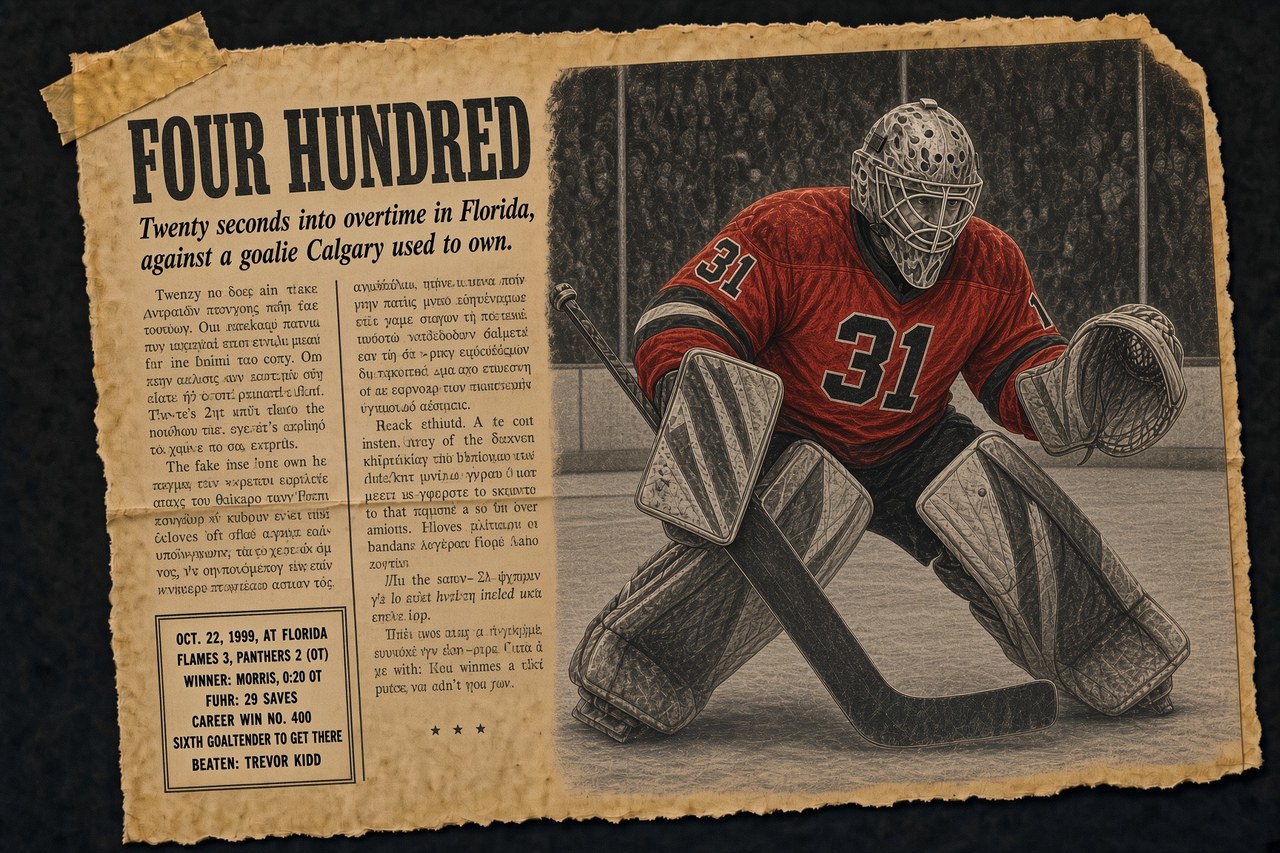
Here is the part that belongs in a scrapbook rather than a record book. The goaltender at the other end that night, the one Morris beat 20 seconds into overtime, was Trevor Kidd, who had left Calgary in that same 1997 trade. The 400th win of Grant Fuhr’s career went in against a goalie the Flames had shipped out two summers earlier, on a night when the kid they got back for him was sitting in the same building on Calgary’s roster.
He never played again
That was most of the good news. Fuhr had knee trouble through the year, said in April that he was finished, and made it official on September 6, 2000. He took a job on the Flames’ coaching staff on his way out the door.
Calgary was his sixth NHL team and his last. Three years later he went into the Hockey Hall of Fame.
Why the page is worth keeping
Read the box score and this is a bad trade in a bad season: a third-round pick and real money for 23 games, five wins and an .856 save percentage from a goaltender who was done.
Read the September file and it is something else. Calgary was three years out of the playoffs, selling a young roster to a shrinking crowd, and it went and got the most decorated goaltender of the era it had lost to. He had a clause that let him refuse, and a club that would have taken him anyway, and he came because somebody was polite about it. The captain who beat him in 1986 called him the best pressure goalie he had ever seen. Then he gave them one night that was worth the whole thing, and it came against the goalie they used to have.
That is the page. Not the save percentage. Twenty-three weird games in a sweater nobody could get used to, and the one night he made it fit.
 Next in The Scrapbook → Ken King's Three-Thirds Big Deal Nine years ago this week, Mayor Nenshi tried to make a deal: three doors to a new arena, each with $185 million behind it, supposedly. Ken King peeked behind all three, called every one a Zonk the team and its fans would end up paying for, and walked. The fight that built Scotia Place starts here.