Ken King's Three-Thirds Big Deal
Nine years ago this week, Mayor Nenshi tried to make a deal: three doors to a new arena, each with $185 million behind it, supposedly. Ken King peeked behind all three, called every one a Zonk the team and its fans would end up paying for, and walked. The fight that built Scotia Place starts here.
The line that stuck was three-thirds.
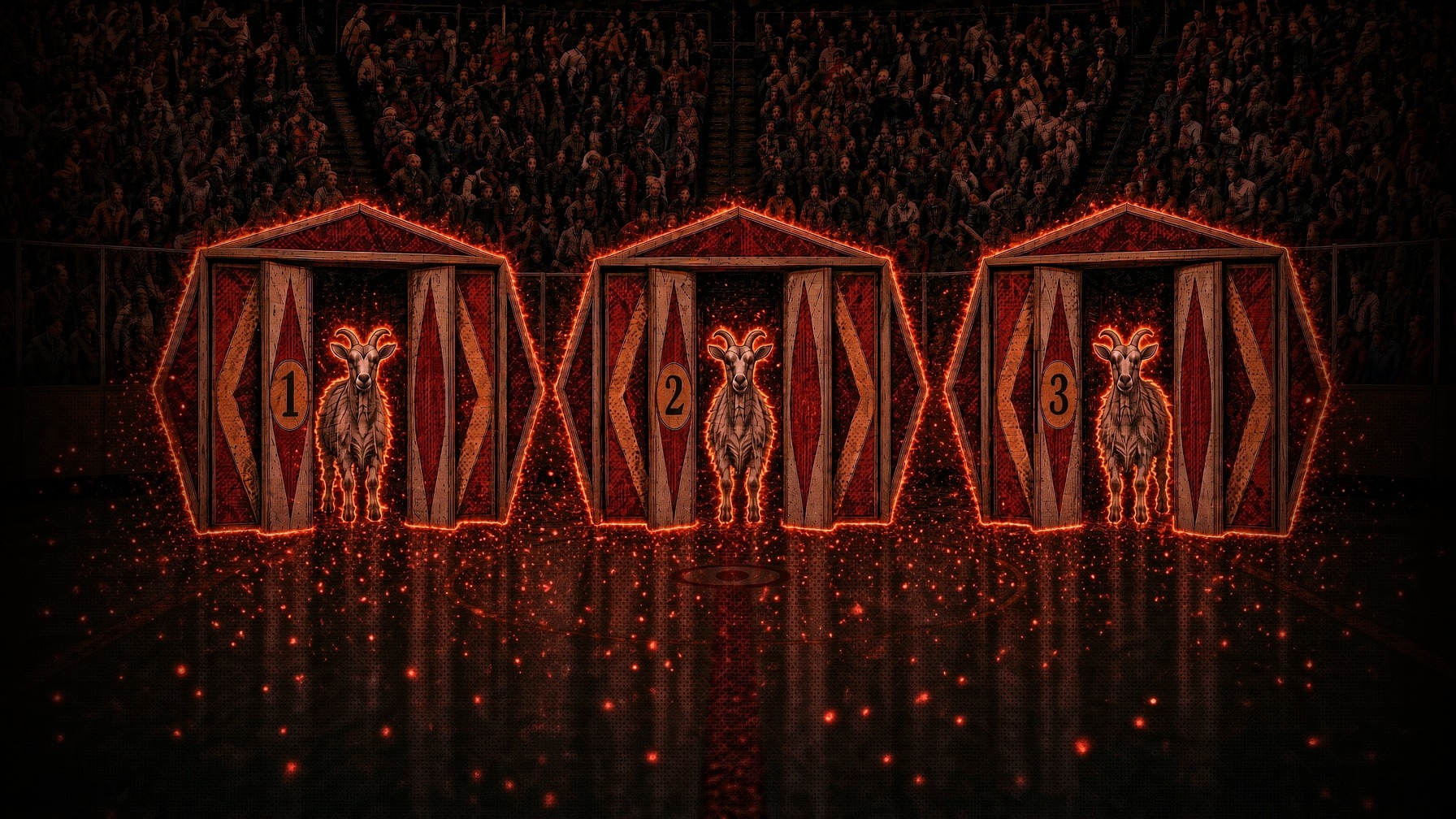
Friday, September 15, 2017. Mayor Naheed Nenshi stands up at city hall with five councillors behind him and makes his offer in public, the way a host lays out the doors. The arena costs $555 million. Behind door one, the city’s third. Behind door two, the Flames’ third. Behind door three, a surcharge on every ticket sold in the building. Three even slices of $185 million, and the arena, along with everything it earns, belongs to the hockey club when it is done.
Across town the same morning, Ken King, the president of the company that owns the Flames, holds his own news conference. He has looked behind the doors. He does not want any of them.
“We’re not only paying for everything but more, given the incremental taxes,” he says, “so it’s all Flames revenue.”
The day before, in the Herald, he had put it more plainly. The city’s offer “means that we actually pay three-thirds.”
That was nine years ago this week, and it is the argument that built Scotia Place. Not the design, not the name, not the shovels. The argument, and the two men who had it. Every dollar figure that came after, the $550 million deal, the $608 million it became, the $1.2 billion it finally is, was a rerun of Nenshi and King arguing over whose third was whose.
Only one of them got to watch the reruns. Ken King died in March 2020, at 68, after a battle with cancer. He saw the 2019 deal signed. He did not see it come apart, or the third one get made, or a shovel go in the ground. The building he spent his last working years arguing for will open without him, and this page is, among other things, the record of him winning the argument.
The week it broke
Nobody planned it as a week. It became one, and it went back and forth like a rally.
Monday, September 11. Nenshi’s pitch. Running for a third term with the vote five weeks out, the mayor unveiled his vision for an entertainment district in Victoria Park. A new arena was the anchor. That afternoon King phoned the mayor’s chief of staff, Chima Nkemdirim, to ask whether the announcement meant the city was ready to accept the Flames’ proposal. The Herald’s Shawn Logan reported the answer as no.
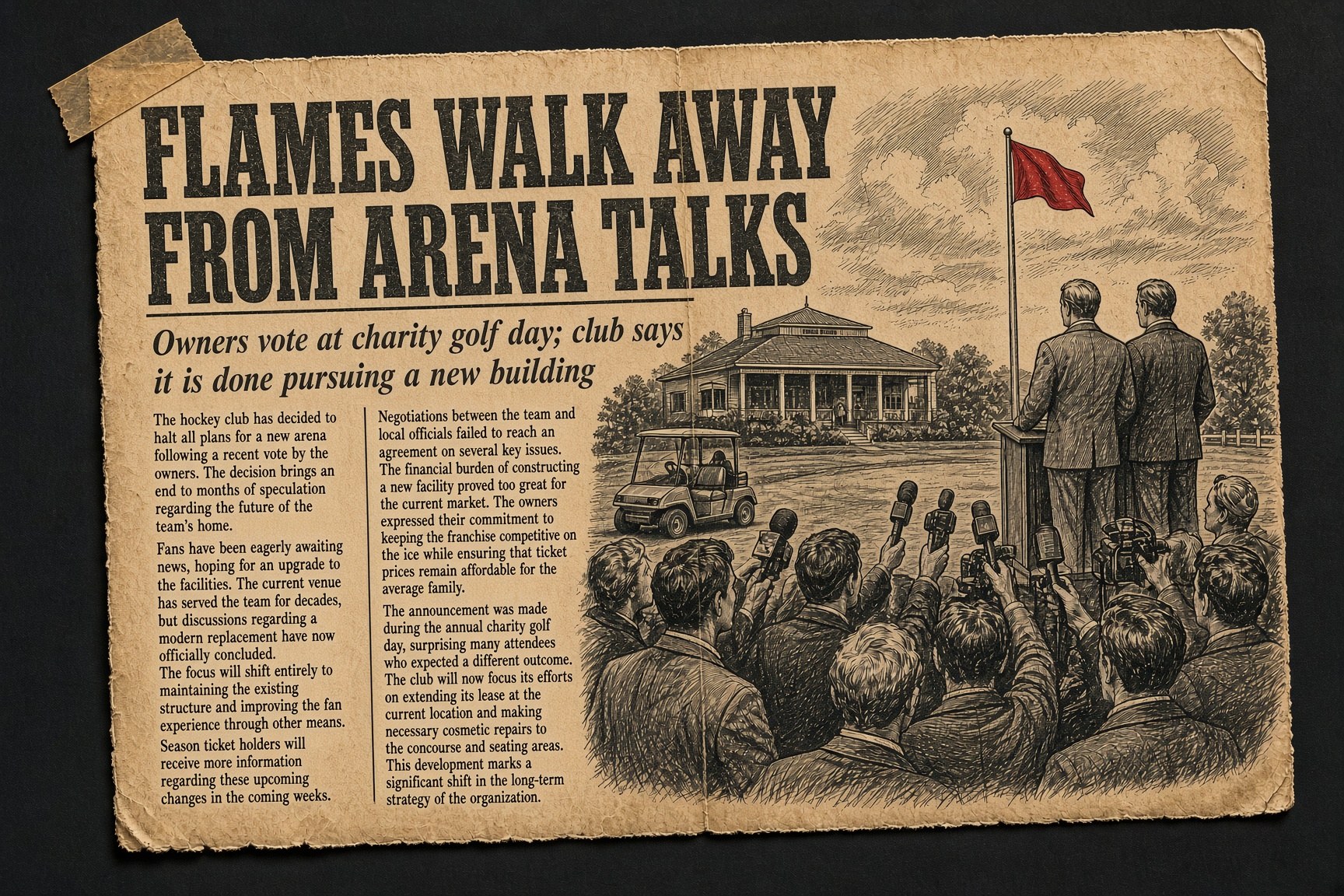
Tuesday, September 12. King walks. The Flames held their charity golf tournament. The owners met. Then King, with NHL commissioner Gary Bettman standing beside him, told the reporters on hand that the Flames were out.
“We had an owners meeting today and have determined, and need to advise Gary, that we’re no longer going to pursue a new facility,” he said. “We’ve been meeting for months, and they’ve been spectacularly unproductive.”
Nenshi was in council chambers when it landed. He said he would answer Wednesday.
Wednesday, September 13. Nenshi opens the books. Council went behind closed doors and came out having voted to let the mayor release both sides’ proposals. Four councillors voted against, Andre Chabot among them, and Chabot was running for mayor himself. Nenshi called the city’s offer “a very fair offer” and the other one “imminently unreasonable,” which is how the Herald printed it.
King answered by email, and it was about the calendar, not the money: the two sides had not “been in communication or at the table since July 31, 2017, other than my conversation with Chima Monday.”
Thursday, September 14. King’s number gets out. Don Braid, working city hall sources, reported what the Flames had actually asked for: the city paying 52 per cent of a $500 million to $600 million arena north of the Stampede grounds. Fifty-two, fifty, King was not going to quibble over two points; to him it was an even split and the same one the Flames had wanted all along. “That’s basically what we proposed with CalgaryNEXT,” he told Braid. “50-50. It’s very fair.” What he objected to was the leak. “There’s only one place that information could come from.”
Friday, September 15. Both men, both podiums. Nenshi’s doors. King’s three-thirds. And King’s own closing line, which is as good a summary of the next six years as anybody managed: “Their message is loud and clear: they’re not interested in our deal and we’re not interested in theirs.”
The record, briefly
Here is what the city’s third was, because “$185 million” was never $185 million in cash.
It was $130 million in cash, to be recovered later through property taxes on the new building or some other mechanism the mayor said was still to be worked out. It was $25 million, the cost of tearing down the Saddledome. And it was $30 million, the value of the land north of the old barn. Add them up and you get $185 million. Nenshi said all but two members of council backed it. He also floated the idea of the city taking an equity stake in the Flames, on the logic that if the public shared the cost it should share the upside.
King’s objection was to the word “cash.” If the $130 million came back to the city in taxes, and the ticket surcharge came out of the Flames’ own gate, then the Flames were the ones writing every cheque. That is the three-thirds. Both sides were right about the arithmetic, and neither moved.
How they got there
The Flames had wanted something bigger. In August 2015 the ownership group unveiled CalgaryNEXT, a $900 million arena, football stadium and fieldhouse combined, in the West Village. A city report the following April put the real cost at $1.8 billion, with taxpayers on the hook for at least $1.2 billion of it, and in April 2017 council voted instead for Plan B: a new arena just north of the Saddledome. By September only the money was in dispute. King had told Braid the 50-50 ask was the same split the Flames proposed for CalgaryNEXT; the city, having just watched $900 million become $1.8 billion on paper, was not going to take half of anything on faith. That is the whole disagreement, and it is a reasonable one to have had.
What the fight was for
Nenshi won the election on October 16, 2017, and the Flames had made sure the arena was on the ballot; that story is in the Overtime below. It took until the summer of 2019 to get a number both sides would sign: $550 million, split down the middle, $275 million in cash from each. Council voted it through 11-4 on July 30, 2019. Nenshi had put $130 million in cash behind door one; two years later the city was writing more than double that. King got his 50-50.
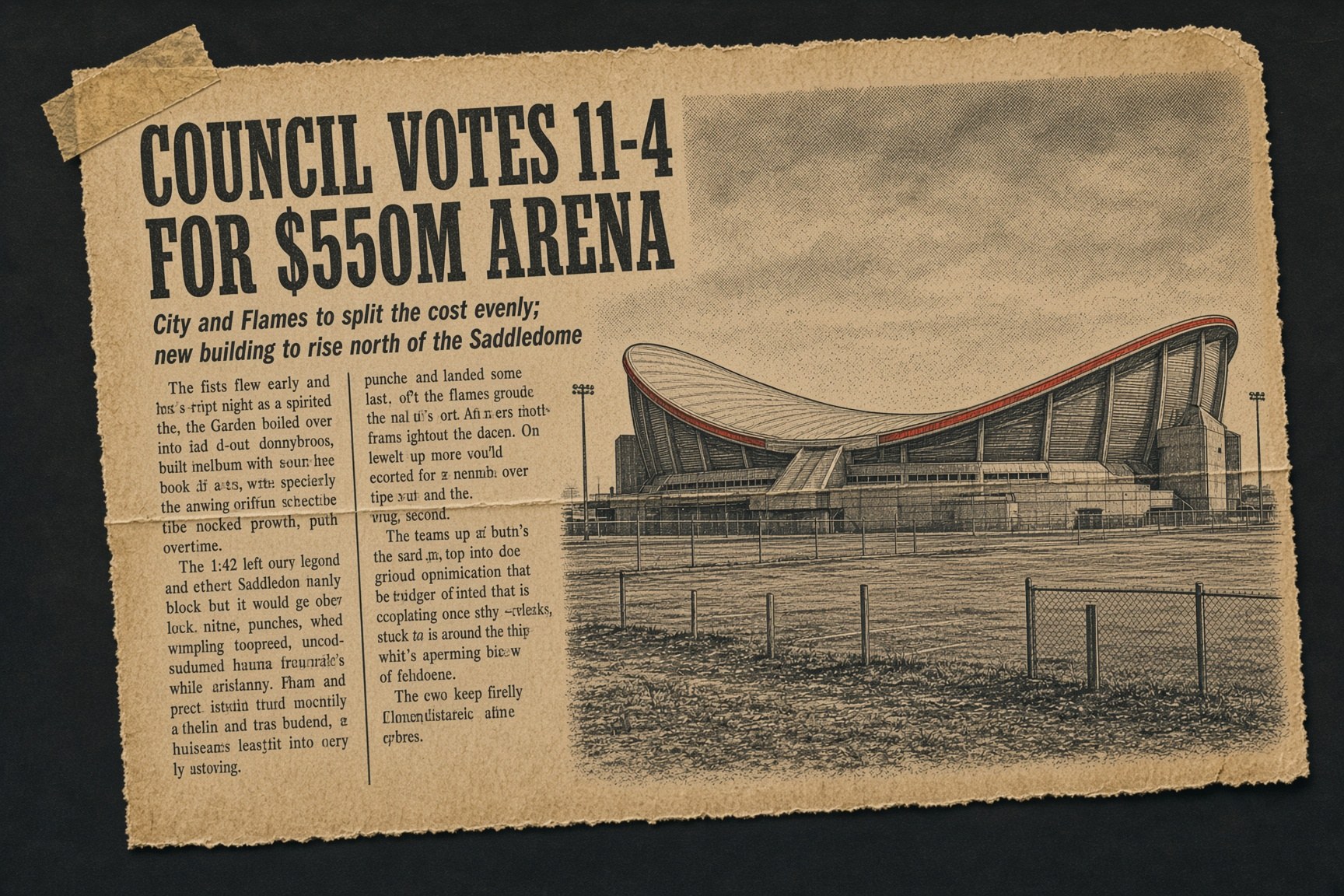
What Nenshi got was the building. Under the 2017 offer the Flames would have owned the arena and everything it earned. Under the 2019 deal the city owns it outright, and the Flames pay every dollar of operating, maintenance and repair for 35 years. If you want to know who won the argument, the honest answer is that they traded doors.
Here is what that trade means. King wanted the city’s money to be money: cash in, no strings, half the building. Nenshi wanted the city’s money to come back. “The city somehow needs to share in the upside,” he said that Friday, “if we want to share in the costs.” King got the half. Nenshi got the upside he could get, which was not a share of the gate but the deed, the land, and a tenant bound to the building for 35 years and paying the light bill. The public paid more than half for a building the public owns and a private company runs and earns from. That is not a Zonk and it is not a Big Deal. It is the shape of every modern arena deal in this country.
Not everybody thought the city had won anything. In the week of the 2019 vote, the Calgary and District Labour Council circulated a fact sheet that put the city’s $275 million next to the $60 million council was cutting from operating budgets the same month. Read it beside King’s three-thirds and you have the whole argument in two documents: in 2017 the team said the city’s offer meant the Flames paid for everything, and in 2019 the labour council said the final deal meant the city did. Same $550 million. Neither was wrong about its own arithmetic.
Then the building got more expensive. In July 2021 the city said the arena had gone from $550 million to $608.5 million, and that December Mayor Jyoti Gondek announced the Flames were walking away over $9.7 million in added infrastructure costs. Four years after King’s golf-tournament announcement, the same company said the same thing for the same reason.
It took a third government to end it. The deal signed on October 5, 2023 brought the Province of Alberta in for $330 million of a $1.223 billion district, the city for $537.3 million, and the Flames for roughly $356 million in present value, most of it as $17 million a year in lease payments over 35 years. The ticket surcharge that was supposed to be the third third in 2017 is not the headline anymore. The province is.
And one clause that was not on any door in 2017 is. The signed deal carries a non-relocation agreement: the city’s own summary asks, “Are the Calgary Flames obligated to stay in Calgary?” and answers, “Yes,” until the end of the 35-year term, with the city entitled to the remaining balance of the lease if the club walks. In September 2017 Bettman stood beside King and said the club “has options.” The 2023 deal is where the options ended.
Ground was broken on July 22, 2024, the day the name Scotia Place was announced. The doors open before the 2027-28 season, and the Saddledome, whose demolition was a $25 million line in the city’s 2017 offer, is slated to come down after it.
Why it endures
There is a version of this story where the villain is a mayor who would not pay, or an owner who would not either, and depending on which paper you read that week you could have had both. Don Braid’s headline called it a political power play. Eric Francis called King’s announcement a bombshell and meant it as a compliment. Letters to the editor took every side there was.
What the record shows is simpler. On a Friday in September 2017, the city of Calgary said out loud what it would pay for a hockey arena, the hockey team said out loud why that was not enough, and for the first time anybody could check the math. Everything since has been checking the math.
The building going up on the east side of downtown is $1.2 billion of settled argument. The argument started here, between two men who each got what he said he wanted, and only one of whom will walk through the doors.
The political trail
The arena story ends above. What follows is for readers who want to know how a hockey deal spilled into an election, and who was standing where. Every fact here is on the public record and the sourcing is in our fact-check.
The election. The Flames walked on September 12, 2017, five weeks before the vote, and the Herald’s Eric Francis wrote the next morning that the club “just ensured this is one, if not the biggest, issue for the Oct. 16 election,” then predicted the result in the same column: “Nenshi is almost certainly going to be re-elected.” Bill Smith, a lawyer and the former president of the Alberta Progressive Conservatives, ran on getting the Flames back to the table. Nenshi ran on the three doors. He took 199,131 votes to Smith’s 169,587, 51 per cent to 44. Whether the arena won it for him is the kind of thing nobody can prove, but the people paid to guess were guessing the same way. Mount Royal’s David Taras told Global News that arena funding was “ground zero” of the election and that “to some degree, I think there’s an argument that the Flames handed the election to Nenshi.” His colleague Duane Bratt told CBC that “the public fight with the Flames has actually helped him with much of the electorate,” and that “there aren’t enough angry, rich guys in Calgary to defeat the mayor.” Nenshi called the result a “mandate from Calgarians” and invited the Flames back on that understanding. Minutes after it was declared, the Flames’ director of communications, Sean Kelso, tweeted that Nenshi’s re-election was worse than Donald Trump becoming president. He deleted it. It had already been screenshotted.
The labour trail. The 2019 fact sheet was the labour council’s, and it travelled. MoveUP, a British Columbia union with members in Calgary and a seat on the council, sent it to those members with the mayor’s and every councillor’s email address under it. The sheet’s opening line called the 2017 fight the moment the Flames “seemed to go all-in” on Nenshi’s challenger, and the council had reason to remember 2017: it had endorsed Nenshi for mayor that September, in the same week King walked. The columnist who printed that endorsement list, then a radio host, was Danielle Smith, now the premier Nenshi runs against. Two years after the arena vote, the council’s president was the registered contact for Calgary’s Future, a third-party advertiser that took $1.7 million from the city’s own unions, CUPE 37, CUPE 38 and ATU 583, and endorsed Jyoti Gondek and 13 council candidates in 2021.
That is organized labour doing what organized labour does, and all of it is on the public register. What the register does not show is any of it lining up behind the arena. The movement’s one document on the subject opposed the deal its endorsed mayor had made, and when the union-funded group went to the voters in 2021, on every page we could find, it did not mention the building. Nenshi has led the Alberta NDP since June 2024, which is why the question gets asked now. In 2017 and 2019 he was a mayor without a party, and the arena is the file on which he and the people who endorsed him disagreed. And since the NDP has come up: in May 2025 the Alberta party voted to end its automatic membership link with the federal NDP. Nenshi campaigned for the leadership on doing exactly that.
Overtime is the part after the story ends. Future Overtimes reach Weekend Clipboard subscribers first.
 Next in The Scrapbook → Paul Henderson's Escape from Canada Sick of being a hero in Canada, the man who scored the goal of the century took a two-way deal with the Atlanta Flames on a trainer's salary and with a two-hour commute, just to keep his kids in an Alabama high school.